Bilingual AI for Cabo Hospitality: What Works in 2026
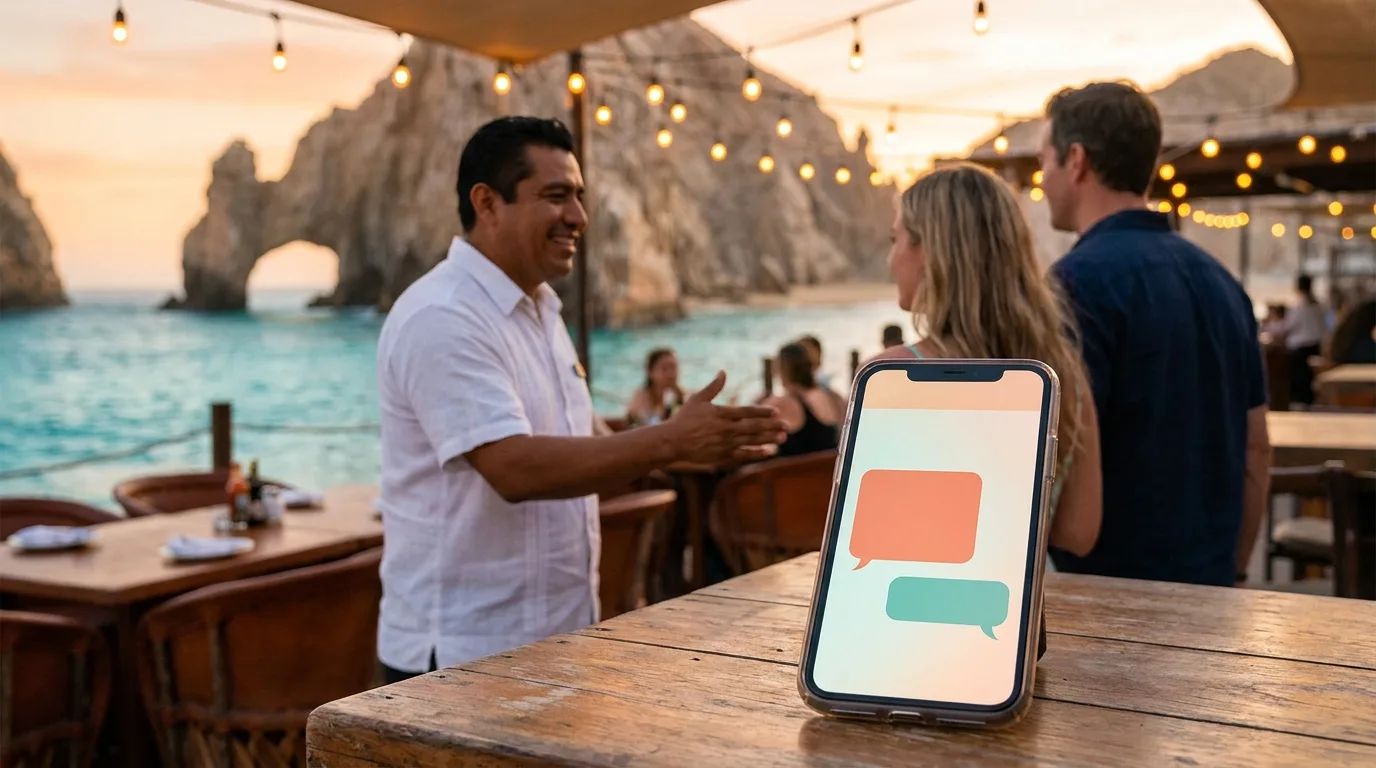
Los Cabos is on pace to welcome 4.13 million tourists in 2025 — a fourth consecutive record year, with 67.9% arriving internationally (FITURCA Los Cabos Observatory, April 2025). That's millions of guests who want to book, ask questions, and share feedback in at least two languages — often switching between them mid-sentence.
And yet, when local hospitality businesses ask about AI, the pitches they receive are almost always built for a monolingual US market.
I've been building AI systems in Los Cabos, in English and Spanish, for about two years. What I've learned is that the bilingual piece isn't a feature request — it's the core problem. Get it wrong, and your AI system actively frustrates the guests it was supposed to serve.
Here's what actually works.
Key Takeaways
- Los Cabos projects 4.13M tourists in 2025, with 67.9% arriving internationally — AI that can't handle bilingual interactions misses most of the market (FITURCA)
- Mexico's AI adoption looks impressive at 38%, but 72% of companies use AI only for basic, isolated tasks — just 3% reached advanced implementation (AWS / Mexico Business News, 2025)
- Top-tier AI models show a 5–20 point accuracy gap between English and Spanish — smaller/cheaper models show gaps of 20–40 points (Cell Patterns journal, 2024)
- The three implementations with real ROI in Cabo hospitality: WhatsApp automation, bilingual reservation confirmation, and AI-driven review responses
The "80% Adoption" Headline Is Misleading
80% of Mexico's tourism companies now implement some form of AI — but the research behind that headline tells a very different story (Mexico Business News / Gupshup, July 2025). When AWS dug deeper, they found that 72% of Mexican companies with AI use it only for basic, isolated tasks. Just 7% apply it to advanced processes. Only 3% have reached true AI maturity (AWS Unlocking Mexico's AI Potential 2025).
What does "basic AI" look like in a Cabo hotel? An English-only FAQ chatbot buried on a website most guests never open. A Google Translate plugin bolted onto the booking page. A WhatsApp autoresponder that sends one confirmation message and goes silent.
That's the gap between the adoption headline and operational reality. Businesses that have crossed into advanced implementation — integrated reservation systems, real-time bilingual guest messaging, dynamic pricing synced with their PMS — are still a small minority. And most of them are large international chains, not the 30-room boutique hotels and family-run restaurants that make up most of Los Cabos's hospitality fabric.
What I've learned: AI projects that pay off don't start by asking "what AI should we use?" They start by mapping where bilingual friction is costing bookings or reviews, then use AI to solve that specific problem. Projects that start with "we need AI" usually end up with something nobody uses.
Why Bilingual AI Is Technically Harder Than Vendors Admit
The gap between English and Spanish performance in top-tier AI models is 5–20 percentage points — and for smaller models, it reaches 20–40 points or more (Cell Patterns journal multilingual LLM survey, 2024). What this means in practice: the same chatbot that handles English guest queries smoothly will misunderstand a meaningful share of Spanish ones.
A 2025 IberBench study testing 23 LLMs across 101 datasets found that Spanish performance varies significantly within Spanish itself — Peruvian, Costa Rican, and Uruguayan Spanish show lower accuracy and more outliers than Mexican or Castilian Spanish (Keepler, May 2025). For Cabo operators, this is actually useful news: Mexican Spanish is among the better-supported regional varieties in leading models.
But the real-world wrinkle isn't Spanish vs. English in isolation — it's code-switching. Guests in a resort town write things like: "¿Tienen late checkout disponible? My flight is at 8 PM." A chatbot trained on clean monolingual data fails at exactly this: a sentence that shifts languages mid-stream, the way bilingual people actually communicate.
According to a 2025 Canary Technologies report, 58% of hotel guests believe AI can improve their stay, and 70% find chatbots helpful for routine requests — but satisfaction drops sharply when the AI responds in the wrong language or makes comprehension errors (Canary Technologies, 2025). In a market this dependent on American visitors, that drop hits your review scores directly.
The bilingual systems that hold up are built on top-tier models like Claude or GPT-4o — specifically because those models maintain meaningful Spanish quality — combined with a reviewed library of Spanish responses for the most common guest scenarios, not purely auto-generated replies.
If you're evaluating a vendor, ask them directly: What model are you actually running? Many "bilingual AI" platforms are wrapper products built on older or cheaper models. The English demo looks polished. The Spanish demo is where the gaps appear.
For more on how hotels are deploying AI guest communication in practice, this breakdown of AI chatbots for hotel guest service covers tool selection and realistic 90-day outcomes.
What Works: Three AI Implementations With Real ROI in Cabo
AI chatbots handling routine hospitality queries now resolve around 80% of interactions without staff intervention (Global News Wire via ArtSmart AI, 2025). But implementation quality matters enormously. For Cabo hospitality, three categories are the most practical places to start.
1. WhatsApp-First Guest Messaging
This is the implementation US consultants almost always miss. WhatsApp is the default messaging app across Latin America. In Los Cabos, it's the default communication channel for everything from restaurant reservations to vacation rental check-in codes. An AI system that handles inquiries through a website chat widget but ignores WhatsApp is solving the wrong problem.
The setup that works: a WhatsApp Business API integration (via platforms like WATI or 360dialog) connected to a bilingual AI routing layer. Routine questions get answered automatically in whichever language the guest initiates. Escalations route to a human with full context preserved. Monthly cost runs $200–$600 depending on message volume. For a busy restaurant or mid-size hotel, a handful of recaptured bookings can cover that cost.
2. Bilingual Reservation Confirmation and No-Show Prevention
Restaurant no-show rates of 15–20% are well-documented, and the fix — automated confirmation sequences with deposits or reminders — is straightforward for English-only operations. The bilingual version requires one critical addition: confirmation messages in the guest's preferred language, not one-size-fits-all machine-translated Spanish.
The AI piece here isn't the chatbot. It's the language-detection and routing layer that sends the right message in the right language. A guest who books via Airbnb in English should receive their WhatsApp reminder in English. A walk-in who gives a local Mexican phone number should receive it in Spanish. This level of routing is a $50/month automation setup — not a $5,000 custom build.
3. Bilingual Review Response Management
A common gap I see: reviews left in Spanish get answered in awkward auto-translated English. Nothing signals "we didn't actually understand your experience" faster to a Spanish-speaking guest. AI-powered review response management for hospitality — generating fluent, contextually appropriate replies in the reviewer's language — is the lowest-friction AI implementation available for properties with a review backlog and no bandwidth to write individual responses.
How to Vet an AI Consultant for Bilingual Hospitality Work
Only 5–12% of Mexico's population speaks English, concentrated in resort zones like Los Cabos, Cancún, and Puerto Vallarta (IMCO via The History of English, 2024). That means your AI system needs to serve Spanish-dominant staff just as well as English-speaking guests — and a consultant who's never operated in a bilingual market won't build something that does.
When evaluating an AI consultant for your Cabo or Mexico operation, ask five questions:
1. "Can you demo the system in Mexican Spanish, with code-switching?" Pull up a real guest message that mixes both languages and watch how their system handles it. If the demo only runs in English, the product isn't ready for your market.
2. "Which model is powering the Spanish responses?" If they can't answer clearly, they're probably running a cheaper model under the hood. The accuracy gap between GPT-4o/Claude 3 and a mid-tier model is meaningful for Spanish comprehension.
3. "Do you have WhatsApp Business API integration?" In Cabo, this is non-negotiable. A consultant without this capability is solving the wrong problem.
4. "What happens when the AI doesn't understand something?" The escalation path is where bilingual systems most often fail. Staff should receive the full conversation context in Spanish — not a machine-translated summary that loses nuance.
5. "Have you worked with businesses in Mexico before — not just Spanish-speaking clients?" Mexican labor law, RFC requirements, and the CFDI invoicing system affect automation design in ways a US-only consultant won't anticipate.
The consultants who charge the least are almost always the ones who've built bilingual AI in theory but never operated in a market where Spanish is the default, not the secondary option. That difference shows up immediately in how they design escalation paths, staff training materials, and fallback messaging.
Where to Start If You're Beginning From Zero
If you're a restaurant, hotel, or vacation rental in Los Cabos and you're not sure where AI fits in your operation, start here:
Map your inquiry volume by channel first. What percentage arrives via WhatsApp vs. email vs. booking platforms? This tells you where to deploy, not where it sounds impressive to deploy. Worth pairing this with a local SEO audit for your Cabo business — automation only helps after guests can find you on Google.
Identify your top 15 repeat questions. These are your automation candidates — not edge cases, not unusual requests. The 15 things your staff answers every single day.
Decide your escalation rule before building anything. What question or sentiment level triggers a handoff to a human? Build this rule first and everything else gets easier.
For vacation rentals, the automation that pays off fastest is bilingual guest communication during the check-in and check-out window. For restaurants, it's the confirmation-and-reminder sequence that cuts no-shows. For hotels, it's 24/7 query resolution in both languages. For a broader survey of where Cabo businesses are deploying AI right now — across tour operators, spas, real estate, and more — our breakdown of AI use cases in Los Cabos walks through where AI fits in 2026.
A practical starter setup for a small Cabo property runs $150–$400/month — WhatsApp Business API, a bilingual chatbot layer, and basic review response automation. Not $10,000. Not a six-month engagement. The tools exist; configuration is the work. For the architecture behind a system like this, see our bilingual AI booking system guide for Los Cabos.
Ready to see what this looks like for your specific operation? I do a 30-minute discovery call where I walk through your current inquiry workflow, identify your bilingual friction points, and tell you exactly what an AI build would cost and deliver. No pitch deck — just specifics.
Frequently Asked Questions
Does bilingual AI cost more than English-only AI for hospitality?
Not significantly. The models that support strong Spanish (GPT-4o, Claude 3) are the same ones used for English. The added cost comes from testing, prompt development in Spanish, and building a library of reviewed responses for the most common scenarios. Budget an extra $500–$1,500 in setup time versus an English-only build.
Can a US-based AI consultant build a bilingual system for a Cabo business?
Technically yes — practically, it depends. A consultant who hasn't worked in Mexico will often miss WhatsApp-first communication patterns, Mexican Spanish regional usage, and local operational context (staff roles, booking platforms, CFDI requirements) that affects automation design. The technical capability may be there; the market knowledge often isn't.
What's the best AI platform for bilingual hospitality chatbots in Mexico?
There's no single dominant platform. The key variables are which model it runs and whether it has WhatsApp Business API support. For small to mid-size properties, WATI or 360dialog for WhatsApp, combined with a GPT-4o or Claude-based response layer, is a practical starting point. Enterprise platforms offer deeper PMS integration at significantly higher cost.
How long does a bilingual AI implementation take for a restaurant or hotel?
A basic WhatsApp autoresponder and FAQ chatbot can go live in 2–4 weeks with proper planning. A full bilingual implementation — WhatsApp, reservation confirmation, and review response automation — typically runs 6–10 weeks when done correctly. Factor in 4–6 weeks of testing with real staff before guest-facing launch.
What AI models perform best in Mexican Spanish?
As of 2026, top-tier models — GPT-4o, Claude 3 Sonnet/Opus, and Gemini 1.5 Pro — show the smallest English-to-Spanish accuracy gaps (5–10 percentage points). Mid-tier models fall off more sharply. IberBench data shows Mexican Spanish is among the better-supported regional varieties, which matters for Cabo's specific vocabulary and communication style.
Conclusion
The headline says 80% of Mexico's tourism sector has adopted AI. The reality is that 72% of those adopters are doing the equivalent of using a calculator and calling it digital transformation. The gap between basic and advanced implementation is exactly where Cabo hospitality businesses can differentiate — not by being the first to have a chatbot, but by having one that works in the languages their guests and staff actually use.
Bilingual AI for hospitality isn't a premium add-on. It's the minimum viable product for a market where 67.9% of your guests arrive from another country. Get the language layer right, start with WhatsApp, and measure by bookings recovered and reviews improved — not by features enabled.
If you're building this for the first time or assessing what you've already deployed, this overview of AI automation fundamentals for small businesses covers the cost and implementation basics before you start shopping for vendors.