AI Review Management for Hospitality: 60% More Bookings

Hotels that respond to every review receive 60% more online bookings than equivalent properties that don't respond at all — and yet the average hospitality business takes 6.9 days to reply (ReviewTrackers, 2023). That gap is where revenue leaks.
The problem isn't that operators don't care. It's that managing reviews manually across Google, TripAdvisor, Yelp, Booking.com, and Airbnb is a part-time job by itself. A 30-room boutique hotel in Los Cabos during high season can receive 40–60 new reviews per month — each one deserving a thoughtful, on-brand response.
AI review management tools close that gap. They draft responses in seconds, translate them into Spanish or English, flag urgent negative reviews for human attention, and let you review and approve everything before it goes live. This guide covers exactly how they work, what they cost, and how to set one up. It's the review-management deep-dive inside the AI for Hotels, Restaurants & Tourism: 2026 Playbook.
Key Takeaways
- Hotels that respond to reviews get 60% more bookings than non-responders (Cornell Hospitality Research, 2020)
- 66% of hospitality review responses are now AI-generated — the highest automation rate of any industry (Birdeye, 2025)
- Industry-average response time is 6.9 days; top performers respond in 1.2 days — and average 4.32 stars vs. 3.73 for slow responders (ReviewTrackers, 2023)
- A 1-point improvement in online reputation score increases RevPAR by 1.42% — a compounding effect that adds up fast (Cornell Center for Hospitality Research)
Why Slow Review Responses Are Costing You Real Money
81% of travelers read reviews before booking a hotel — and the majority pay attention to how management responds (MARA Solutions, 2025). A response isn't just courtesy. It's a signal to every future guest reading that thread: this property pays attention, this property cares.
The revenue math is concrete. Cornell Center for Hospitality Research found that a 1-point improvement in Global Review Index (GRI) score translates to a 0.89% increase in average daily rate, a 0.54% increase in occupancy, and a 1.42% increase in RevPAR. For a hotel generating $1M in annual revenue, that's $14,200 per point — compounding.
For restaurants, Harvard Business School research on Yelp found that a 1-star rating increase yields a 5–9% revenue increase for independent restaurants. Same principle, same direction: online reputation directly moves your top line.
The problem is volume. Hotel staff globally spend an estimated 37,350 hours per day responding to reviews — calculated from nearly 1 million hotel reviews published daily at an average 6-minute response time (MARA Solutions, 2025). For a small property, that's not abstract. It's 2–3 hours every day that your front desk manager isn't spending on operations.
Working with hospitality businesses in Los Cabos, the review queue is the task that most operators do last — after check-ins, staffing, and everything urgent. Which means it often doesn't get done at all. The reviews pile up, unanswered, while guests considering your property read the silence as indifference. AI tools don't replace your judgment on sensitive responses; they handle the 80% of straightforward replies so you can focus on the 20% that actually need you.
What Can AI Review Management Actually Do?
66% of hospitality review responses are now AI-generated — the highest automation rate among all measured industries (Birdeye State of Online Reviews, 2025, surveying 200,000+ U.S. businesses across Jan–Dec 2024). That's not a future trend. It's the current operational reality for the businesses pulling ahead on response rates.
Here's what AI review management tools handle:
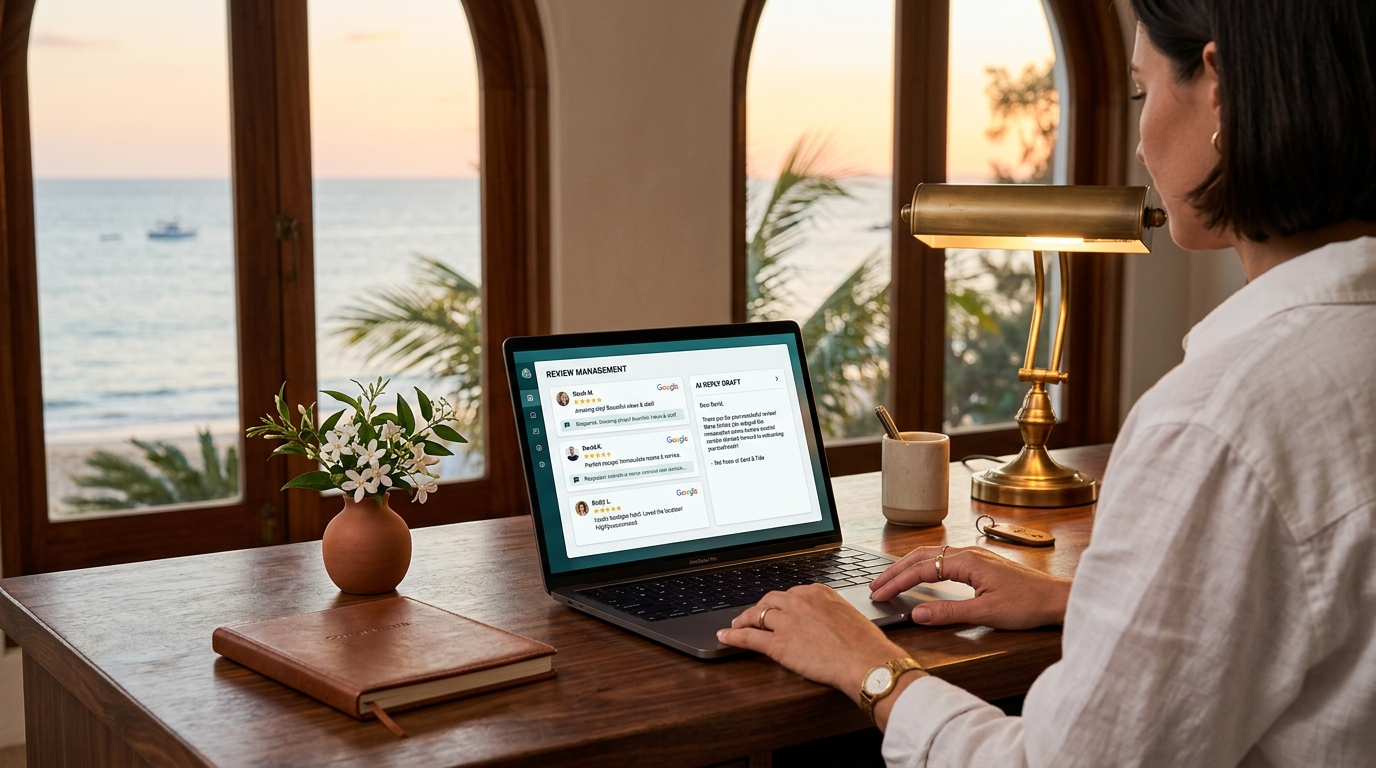
Drafting responses — The AI pulls in reviewer name, rating, specific comments, and generates a contextually relevant response draft. For a 4-star review mentioning the pool and the slow bar service, it writes something that acknowledges both — not a generic "thank you for your feedback."
Multi-platform aggregation — One dashboard pulls reviews from Google, TripAdvisor, Booking.com, Yelp, Airbnb, and Facebook. You respond once; the tool routes it to the right platform.
Language detection and translation — A guest who writes in Spanish gets a Spanish response. A guest who writes in German gets a German response. For Los Cabos properties serving international guests, this is practical rather than nice-to-have.
Negative review flagging — Low-star reviews with specific complaints are flagged for human review before any response goes out. The AI doesn't auto-publish to an angry 1-star review; it surfaces it to you with a draft that you approve, edit, or override.
Sentiment analysis and trend reporting — The platform tracks what guests mention most often (slow check-in, noisy rooms, great breakfast) so you know what operational issues to actually fix, not just respond to.
What AI doesn't do: make judgment calls on complex guest disputes, issue refunds, or write responses that require knowing the specific situation. Those stay with your team. The AI handles the volume so you have capacity for the exceptions.
Which AI Review Management Tools Work Best for Small Hospitality Businesses?
The overall industry review response rate jumped from 63% in 2023 to 73% in 2024 — a 10-point increase driven almost entirely by AI tooling (Birdeye, 2025). The tools making that possible range from simple standalone apps to full reputation management platforms.
Here's how the practical options break down:
| Tool | Best For | Monthly Cost | Key Strength |
|---|---|---|---|
| MARA Solutions | Hotels, boutique properties | ~$79–$199/mo | Purpose-built for hotels; multilingual; AI drafts in guest's language |
| Widewail | Restaurants, multi-location | ~$149–$299/mo | Human-AI hybrid; optional human review before publish |
| Birdeye | Multi-location operators | ~$299+/mo | Broadest platform integration; SMS review requests |
| ReviewTrackers | Mid-size hospitality | Custom pricing | Strongest analytics; competitor benchmarking |
| Podium | Restaurants, service businesses | ~$249–$399/mo | Best for getting more reviews via SMS; plus AI responses |
| Make.com + OpenAI | Budget-conscious / DIY | ~$49–$99/mo | Custom workflow; lower cost; requires setup time |
For independent hotels and boutique properties — MARA Solutions is purpose-built for hospitality and handles multilingual responses natively. It's the most practical starting point if your primary concern is response quality and language coverage.
For restaurants — Widewail or Podium. Podium is especially useful if you also want to generate more reviews via post-visit SMS requests, not just respond to existing ones.
For operators with multiple locations or properties — Birdeye or ReviewTrackers provide the cross-location analytics that make management at scale practical.
For budget-conscious operators — A Make.com workflow connecting Google Business Profile API + OpenAI can draft responses for $49–$99/month. It requires 4–6 hours of initial setup but gives you full control at the lowest ongoing cost.
The tool decision that most operators overlook: response approval workflow. Some platforms auto-publish AI responses; others queue them for human approval. For a small property, auto-publish for 4-5 star reviews and human-approval for anything under 4 is the right default. The risk isn't that AI writes a bad response — it's that auto-published responses to 1-star reviews occasionally miss context that only the property knows. Build in one human checkpoint for negative reviews; automate everything else.
For a broader comparison of automation tools by business type, see our guide to choosing AI automation tools.
How to Set Up AI Review Management: A 4-Step Process
Setting up a review management workflow takes 2–4 hours and runs on autopilot after. Here's the sequence that works:
Step 1: Audit Your Current Review Footprint
Before you configure anything, understand what you're working with. Log into Google Business Profile, TripAdvisor, Yelp, and any booking platforms your property uses. Note:
- How many reviews you have on each platform
- Your current average rating on each
- How many reviews have unanswered responses
- What your response rate percentage shows (Google GBP shows this in your dashboard)
Most operators are surprised how many unanswered reviews they have. A backlog of 50 unanswered reviews is normal for a property that's been running manually. Clear the backlog first — AI tools make this fast.
Step 2: Choose Your Platform and Connect Your Accounts
Sign up for a free trial of your chosen tool (most offer 14-day trials). Connect:
- Google Business Profile (OAuth connection, takes 2 minutes)
- TripAdvisor Management Center
- Yelp for Business
- Booking.com extranet
- Airbnb host account (if applicable)
Most platforms support all five out of the box. After connecting, every new review across all platforms appears in a single inbox.
Step 3: Configure Your Brand Voice and Response Rules
This is the most important setup step — and takes 30 minutes, not hours. Configure:
Brand voice parameters — Formal or casual? First name or "Dear Guest"? Signature format? Upload 5–10 of your best past responses as examples; most tools use these to calibrate tone.
Language settings — Enable multilingual response for the languages your guests use. For Los Cabos properties: English and Spanish at minimum; add Portuguese and French if your guest mix warrants it.
Approval workflow — Set auto-publish rules for 4-5 star reviews with no specific complaints; set human-approval required for 1-3 star reviews or any review mentioning a specific staff member by name.
Alert rules — Immediate email/SMS notification for any review under 2 stars or containing keywords like "refund," "manager," or "never again."
Step 4: Build a Weekly Review Cadence
Once the system is running, your weekly review management task takes 20–30 minutes:
- Review and approve AI-drafted responses for flagged negative reviews
- Check the sentiment trend report (are pool complaints increasing? Is breakfast getting more mentions?)
- Respond to any reviews the AI flagged as needing human context
That's it. The AI handles the volume; you handle the judgment calls.
For properties looking to also increase review volume alongside response quality, the automated guest communication systems we've covered for vacation rentals include post-checkout review request automation — timed to reach guests 12–24 hours after checkout when their experience is freshest.

What Results Should You Expect?
Consumers are 41% more likely to choose a business that responds to all its reviews versus one that responds to none (BrightLocal Local Consumer Review Survey, January 2025, n=1,026 U.S. adult consumers). That preference translates directly into bookings.
The benchmarks for a typical 30–80 room hotel or restaurant deploying AI review management:
Month 1: Response rate increases from whatever baseline to 90%+. Backlog cleared. New reviews get responses within 24 hours instead of days.
Month 2: Average rating begins to improve. Responding to 1-2 star reviews within 24 hours yields a 33% higher probability of review upgrades — where a guest updates their rating after seeing a thoughtful response (ReviewTrackers, 2023).
Month 3+: Consistent high response rate improves visibility in Google and TripAdvisor ranking algorithms. More reviews and consistent responses signal to search algorithms that the property is actively managed.
From deployments with hospitality clients in Los Cabos: the first thing that changes isn't the star rating — it's the owner's relationship with reviews. When responding no longer feels like a burden (because the AI handles drafting), operators start to use the review data differently. They start noticing patterns: "three guests this month mentioned the check-in was confusing." That operational intelligence was always there. It just required clearing the review queue first to see it.
The ROI for most hospitality properties is straightforward:
- Tools cost $79–$299/month
- Incremental bookings from improved response rate recover that cost typically in the first week
- Permanent improvement to your online reputation compounds over months and years
For a detailed breakdown of how automation investments return across a hospitality operation, see our AI automation ROI guide.
Ready to Stop Letting Reviews Manage You?
Online reviews are the highest-traffic marketing channel most hospitality businesses have — and most operators treat them reactively, when they remember. The properties pulling ahead are the ones that have made review management systematic: automatic drafts, fast approvals, consistent response rates, and operational intelligence from sentiment data.
The tools are affordable, the setup is manageable, and the compounding effect on ratings and visibility is real.
Want to see what a review management workflow would look like for your specific property — and what it would cost? Book a free 30-minute call. I'll audit your current review footprint and map out the exact setup.
If you're still evaluating whether automation is right for your operation, read our guide on 7 signs your business is ready for AI automation. Or if you're a restaurant owner looking to tackle no-shows before review management, start with how restaurants use AI to reduce no-shows by 40%.
Frequently Asked Questions
How much does AI review management cost for a small hotel or restaurant?
Entry-level tools like MARA Solutions start at $79/month; mid-tier platforms like Widewail run $149–$299/month. A DIY setup using Make.com + OpenAI costs $49–$99/month with 4–6 hours of initial setup. Most properties recover the monthly cost within the first week through incremental bookings from improved response rates and ratings.
Will AI-generated review responses sound robotic or generic?
Not with modern tools. Platforms like MARA and Widewail pull in reviewer name, star rating, and specific comments to write contextually relevant responses — not templates. The key is uploading 5–10 of your own best past responses during setup so the AI calibrates to your voice. Most guests can't distinguish AI-drafted responses from human ones when the tool is properly configured.
How quickly should hospitality businesses respond to reviews?
53% of customers expect a response to negative reviews within one week; 33% expect within three days (ReviewTrackers, 2023). Top-performing hospitality businesses respond in an average of 1.2 days. For negative reviews specifically, responding within 24 hours yields a 33% higher probability the reviewer will update their rating. AI review tools make sub-24-hour response rates achievable at any volume.
Which review platforms matter most for hospitality?
Google is the highest-priority platform for search visibility and local SEO. TripAdvisor drives significant booking influence for hotels and restaurants. For vacation rentals, Airbnb and VRBO reviews directly affect search ranking and booking conversion. Yelp matters primarily for restaurants in urban US markets. A good review management tool connects all of them in one dashboard — you don't need to manage each separately. For more on how your website and local presence interact, see our guide on AI chatbots for hotels.
Can AI review management help get more reviews, not just respond to them?
Yes. Platforms like Podium and Birdeye include review request automation: post-visit SMS or email that prompts satisfied guests to leave a review while their experience is fresh. This is especially effective for restaurants and shorter stays. For vacation rentals, the review request timing (12–24 hours after checkout) is a standard part of automated guest communication workflows.
Do I need to respond to positive reviews, or just negative ones?
Both — but they serve different purposes. Responding to positive reviews shows future guests that management is engaged and appreciative. Responding to negative reviews shows you take problems seriously and gives you a chance to reframe the narrative. Consumers are 41% more likely to choose a business that responds to all reviews (BrightLocal, 2025). With AI drafting, responding to everything takes minutes per day instead of an hour.
The Bottom Line
Your online reviews are being read by every potential guest before they book. Whether your response rate is 20% or 95% — and whether your responses take 6 days or 6 hours — is visible to all of them. The hospitality businesses that respond well, respond fast, and respond to everyone aren't doing it manually. They've automated the drafting so they can focus on the exceptions.
AI review management won't fix a genuinely bad guest experience. But it ensures that every good experience gets amplified, every complaint gets addressed, and your online reputation reflects the actual quality of your operation — not just whoever remembered to check the review inbox last week.
For a full picture of what AI automation can do across your hospitality operation — from no-shows to food waste to guest communications — our AI restaurant inventory management guide shows how automation stacks across every cost center.