Restaurant AI: How to Cut No-Shows from 20% to Under 3%
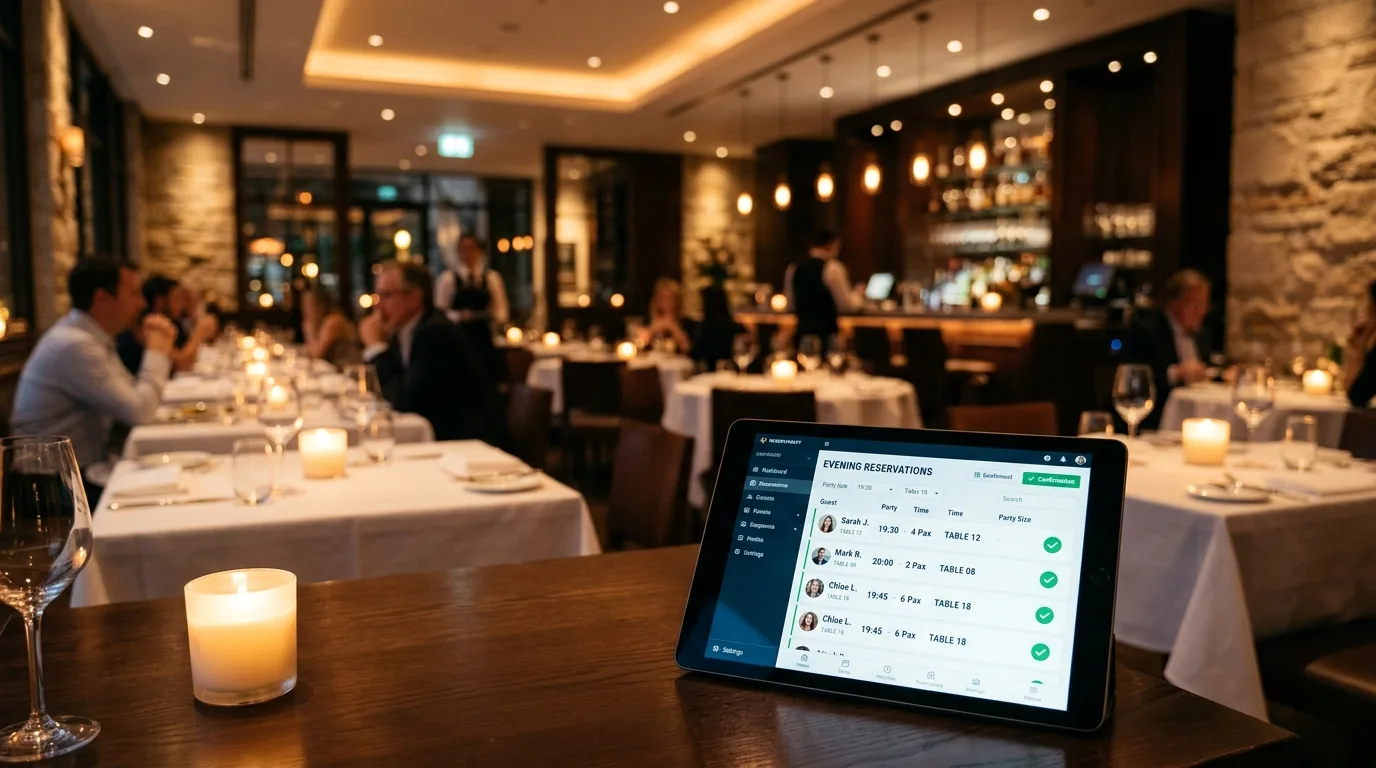
No-shows cost the restaurant industry an estimated £16 billion annually in the UK alone — and US data paints the same bleak picture. Tablein (2024) reports that up to 1 in 5 reservations in urban centers are no-shows. That's a prep-wasted, staff-paid, table-empty loss every single service.
The good news: AI-driven reservation tools have changed the math entirely. Full prepayment through platforms like Tock drops average no-show rates to 0.9%. SMS-based confirmation systems achieve 98% open rates. And deposits through OpenTable cut cancellations by an average of 57%.
This post breaks down exactly how these tools work, which strategies deliver the biggest reductions, and what it realistically costs a restaurant to set them up. It's the no-shows deep-dive inside the broader AI for Hotels, Restaurants & Tourism: 2026 Playbook, which maps every hospitality workflow AI is solving right now.
Key Takeaways
- Up to 20% of urban restaurant reservations are no-shows — and 28% of Americans admit to skipping a reservation in the past year (OpenTable, 2021)
- Full prepayment via Tock reduces no-show rates to just 0.9% — down from a 10-20% baseline (Tock, 2024)
- SMS confirmation messages have a 98% open rate vs. 20% for email, making automated texts your highest-leverage reminder channel (SevenRooms, 2025)
- AI reservation tools from SevenRooms, OpenTable, and Tock start at $49–$499/month and typically pay for themselves after recovering 2–3 covers per week
What Does a No-Show Actually Cost Your Restaurant?
A single no-show at a restaurant with a $70 average check costs far more than the lost meal. A 20% no-show rate on a 50-cover dinner service means 10 empty tables — while you've already staffed for them, prepped the ingredients, and turned away walk-in guests.
OpenTable's 2021 survey (conducted with YouGov, n=1,326 US adults) found that 28% of Americans admitted to skipping a reservation they had made in the past year. That statistic hasn't improved — if anything, post-pandemic reservation culture has made no-shows a structural problem rather than an occasional frustration.
For a 60-seat restaurant running two dinner services per day, even a 15% no-show rate represents:
- ~9 empty seats per service
- $630–$1,350 in lost cover revenue per service
- $2,520–$5,400 in lost revenue per week
That's $131,040–$280,800 annually — revenue that automated systems can recover for $49–$499/month.
For a full breakdown of what automation investments return, see our AI Automation ROI guide.
How Do AI Reservation Systems Actually Reduce No-Shows?
Modern AI reservation tools work through three mechanisms: automated SMS/email reminder sequences, deposit and prepayment requirements, and AI-powered waitlist management. SevenRooms' 2024 U.S. Restaurant Trends Report (commissioned via Censuswide) found that 70% of U.S. restaurant operators now use AI in some capacity — and 35% specifically use it for reservation processing. Reservations are just one layer; for the full restaurant stack — phone answering, POS, scheduling, and bilingual guest messaging — see the 7 best AI tools for restaurants in 2026.
Here's how each layer contributes to no-show reduction:
Layer 1 — Automated Confirmation Sequences When a guest books, the system immediately sends a confirmation with a "Confirm / Cancel" link. A follow-up message goes out 48 hours before the reservation, and a final reminder 2 hours before service. If the guest doesn't confirm, the system flags the reservation for the host or releases the table for walk-ins automatically. For restaurants comfortable with technical tools, n8n can build this entire sequence using a Webhook trigger and Twilio nodes — running unlimited daily reminders at near-zero ongoing platform cost. If your guests are in Mexico, WhatsApp automation hits a 90%+ read rate vs. SMS because that's the channel they actually check — same workflow, far higher engagement.
Layer 2 — Deposits and Prepayments Guests who've paid something — even a $10–$25 deposit — are dramatically more likely to show. The psychology is straightforward: money is on the line. OpenTable calls this "payment friction," and their platform data shows it works.
Layer 3 — AI-Powered Waitlist Management When a cancellation comes in, AI systems can instantly text the next guest on the waitlist, fill the table within minutes, and recover revenue that manual systems would lose entirely. A last-minute cancellation at 6:45 PM becomes a filled table by 7:10 PM.
Working with hospitality businesses in Los Cabos, I've found that the 48-hour confirmation step is where most restaurants lose guests they could have saved. A single automated text with a one-tap "I'm coming" confirmation recovers 30–40% of potential no-shows before they happen. The technology to do this costs less than a single food order from a table that never shows.
According to SevenRooms' 2025 text marketing research, operators using their SMS tools see a 24x average ROI and $1,800 average revenue per campaign — driven primarily by confirmation sequences and last-minute table fill automation.
Which Strategy Cuts No-Shows the Most?
The data is unambiguous: prepayment is the single most effective no-show reducer. Tock's platform data from December 2023 to March 2024 shows that restaurants using full prepayment averaged a 0.9% no-show rate, while credit card holds produced a 3% rate. Without any system, industry averages sit at 10–20%.
IntoTheMinds studied 39 Michelin-starred restaurants across 18 countries and found that 92% require a credit card deposit — and those restaurants reported approximately 1% no-show rates. The deposit isn't just a financial protection tool; it's a behavioral commitment mechanism.
The concern most independent restaurant owners have: "Will deposits drive away customers?" The honest answer is that deposits reduce overall reservation volume by roughly 10–15% — but the guests who drop off are disproportionately likely to be no-shows anyway. Net revenue typically increases even with fewer total reservations.
The right approach depends on your restaurant type:
- Fine dining / tasting menu: Go full prepayment. Guests expect it.
- Mid-market / upscale casual: Credit card hold or 25–50% deposit.
- Casual / neighborhood bistro: Start with SMS reminders and add a card hold once guests are used to the system.
For help deciding which approach fits your situation, see AI Automation vs. Hiring: When to Automate.
Case Study: Long Meadow Ranch Drops No-Shows from 15% to 1%
Long Meadow Ranch, which operates Farmstead restaurant in California's Napa Valley wine country, implemented SevenRooms deposits and saw their no-show rate collapse from 15% to 1% — an 85% reduction. According to SevenRooms' published case study (September 2025), the change didn't significantly hurt reservation volume. Guests who were serious about coming were willing to commit.
This pattern holds consistently: the guests you lose when you add a deposit are the guests who were most likely to ghost you anyway.
I've helped restaurants in Los Cabos set up similar workflows using SevenRooms and Make.com. The setup — configuring the deposit flow, building the SMS confirmation sequence, testing the cancel-and-waitlist automation — takes about a day. After that, it runs automatically and requires zero manual effort per reservation. For the full implementation roadmap tailored to Los Cabos operations — including bilingual reminder templates and local tool costs — see the guía de automatización IA para restaurantes en Los Cabos (en español).
The ROI math is straightforward for most restaurants:
- 80 covers per dinner service × 15% no-show rate = 12 empty covers per night
- At $65 average check = $780 in nightly lost revenue
- SevenRooms subscription: $499/month
- Break-even: 1 week of operation
What Do AI Reservation Tools Actually Cost?
AI reservation platforms range from $49 to $499/month depending on restaurant size and feature set. Here's a practical comparison:
| Tool | Starting Price | Key No-Show Feature | Best Fit |
|---|---|---|---|
| OpenTable | ~$149/mo | Deposits cut no-shows by 57% | Full-service restaurants |
| SevenRooms | ~$499/mo | Full CRM + SMS automation | Mid-size to upscale |
| Tock | Custom pricing | Full prepayment → 0.9% no-shows | Fine dining, ticketed events |
| Make.com + Twilio | ~$49–$99/mo | Custom SMS reminder sequences | Budget-conscious / DIY |
For restaurants not ready to invest in a full reservation platform, a custom automation built in Make.com can handle the SMS reminder layer for $49–$99/month. It won't provide the deposit functionality of dedicated platforms, but it handles 48-hour and 2-hour confirmation sequences — which alone can cut no-show rates by 30–40%.
Based on conversations with restaurant operators across Los Cabos and California, the practical break-even threshold for most reservation management tools is recovering 2–3 additional covers per week. For any restaurant with an average check above $40, any tool under $150/month pays for itself quickly — often within the first week.
For step-by-step instructions on building SMS automations, see Getting Started with Make.com.
To understand total automation investment across your business, see our AI automation cost guide.
How to Start: A 3-Step Implementation Plan
You don't need to overhaul your entire reservation system to start cutting no-shows. Here's the minimum-viable approach, ordered by impact:
Step 1 — Add a 3-Message SMS Confirmation Sequence ($49–$99/mo)
- Booking confirmation (immediate): "Thanks for booking at [Restaurant Name]! We'll see you [Date] at [Time] for [Party Size]. Reply YES to confirm."
- 48-hour reminder: "Your reservation at [Restaurant Name] is tomorrow at [Time]. Reply YES to confirm or CANCEL if plans change."
- 2-hour reminder: "We're looking forward to seeing you tonight at [Time]! Your table will be held for 15 minutes."
Build this in Make.com with a Twilio integration for $49–$99/month total.
Step 2 — Add a Credit Card Hold at Booking ($0 extra with OpenTable/Resy) Most modern reservation platforms include this as a standard feature. Enable it and your no-show rate drops from ~15% to ~3% overnight.
Step 3 — Move to Deposits or Prepayment for High-Demand Times For Friday/Saturday dinner service or holidays, require a 25–50% deposit. Guests booking weeks in advance expect this at a quality restaurant. For these services specifically, your no-show rate will approach 1–2%.
Ready to Stop Losing Revenue to Empty Tables?
According to Deloitte's 2025 AI in Restaurants research (375 restaurant executives, 11 countries), 82% of restaurant executives expect AI spending to increase next fiscal year, and 63% already use AI daily for customer experience. The restaurants adopting these tools now are building a structural advantage over competitors still running manual operations.
The technology is off-the-shelf, affordable, and doesn't require technical expertise to implement. The only question is how quickly you want to recover the revenue you're currently leaving on the table.
Want me to audit your current reservation process and show you exactly what it would cost to automate? Book a free 30-minute call — I'll map out the exact setup for your restaurant.
If you're unsure whether your business is ready for automation, read 7 Signs Your Business is Ready for AI Automation.
Frequently Asked Questions
How much does restaurant no-show automation cost?
Entry-level SMS automation via Make.com + Twilio runs $49–$99/month. Full platforms like OpenTable start at ~$149/month and SevenRooms at ~$499/month. Most restaurants recover these costs in the first week by recapturing 2–3 covers that would otherwise be no-shows. At a $65 average check, that's $130–$195 per week in recovered revenue.
Do deposits actually reduce reservation volume?
Deposits typically reduce total bookings by 10–15% — but those guests are disproportionately likely to be no-shows. Tock's data shows full-prepayment restaurants achieve a 0.9% no-show rate. Net revenue increases in almost every case because filled tables replace previously empty ones.
What no-show rate should I be targeting?
Industry average without any system is 10–20%. With SMS reminders: 8–13%. With a credit card hold: 3–5%. With deposits or prepayment: 1–2%. Fine dining restaurants can reasonably target under 1% with full prepayment. Casual dining targeting 3–5% is a realistic and achievable goal.
Can I set up SMS reservation reminders without a technical background?
Yes. Platforms like OpenTable and SevenRooms have built-in SMS reminder features that require no coding. The Make.com + Twilio DIY approach takes 3–5 hours of setup with no programming experience required — there are visual, drag-and-drop workflow builders. See our Make.com beginner's guide for step-by-step instructions.
Which is better — SMS reminders or email reminders for restaurant reservations?
SMS is significantly more effective. SevenRooms (2025) reports SMS open rates of 98% vs. 20% for email. Guests are far more likely to see and act on a text message than an email that sits in their inbox. Use SMS for time-sensitive confirmations and reserve email for post-visit follow-ups and marketing.
The Bottom Line
No-shows are a solvable problem. The data from Tock, OpenTable, SevenRooms, and Deloitte all points to the same conclusion: a combination of automated confirmation sequences and payment requirements can take a 20% no-show rate down to under 3% within 30 days of implementation.
The tools are affordable. The setup is manageable. The ROI is immediate. The restaurants that act on this now will spend the next two years with structurally lower operating costs than their competitors still running manual reservation systems.
For properties that run both a restaurant and hotel rooms or suites, AI chatbots can handle 85% of hotel guest inquiries around the clock — the same 24/7 automation logic applied to the rooms side of the business. To avoid common pitfalls when rolling out automation, read Common AI Automation Mistakes Small Businesses Make. Once no-shows are under control, the next highest-impact move for most restaurant operators is automating inventory management with AI — which cuts the other major variable cost: food waste by up to 50%. And every satisfied guest who does show up is a potential reviewer — AI-powered review management ensures their experience turns into public social proof that fills future tables.