Landing Page vs Website: 6.6% vs 2.9% Conversion (2026)
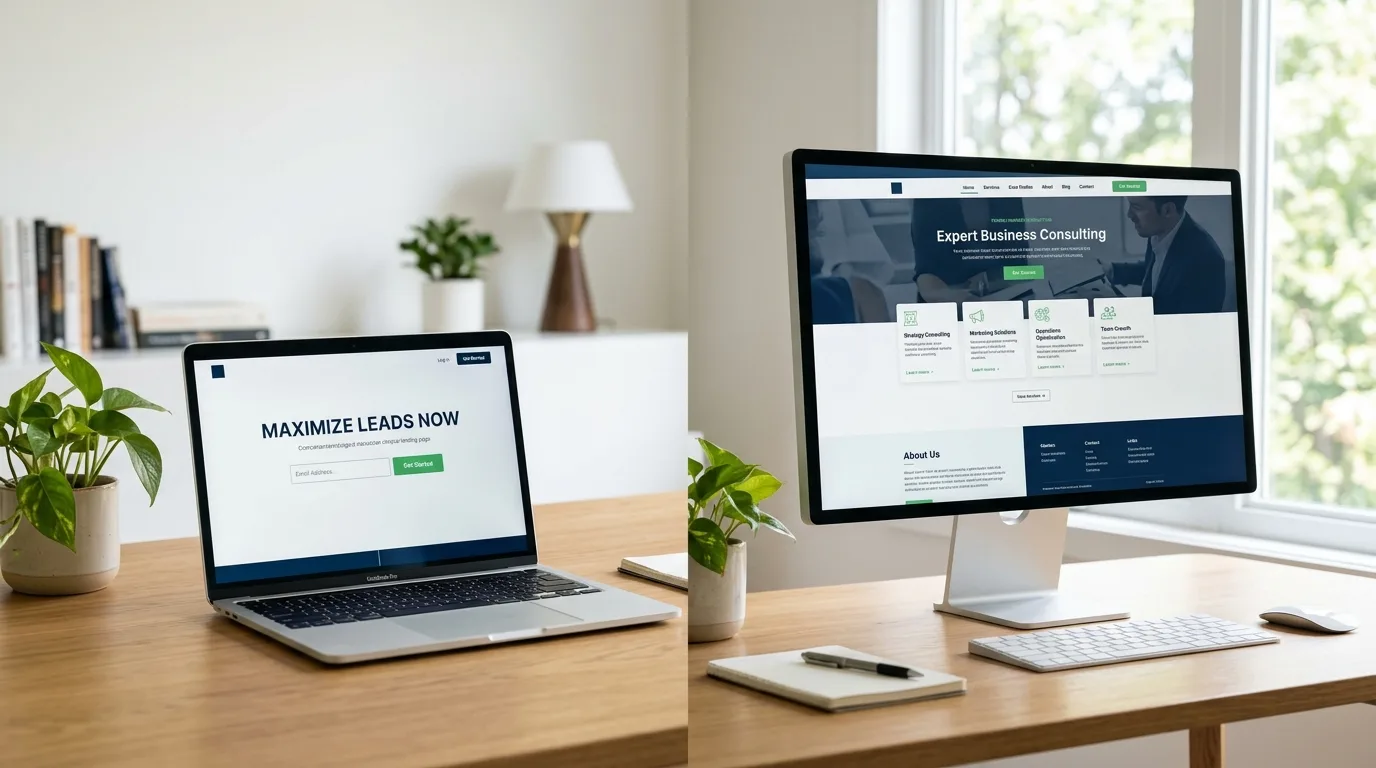
The fastest way to waste $5,000 as a small business owner is to build a 10-page website when what you actually needed was a $200 landing page — or vice versa. I see this every month with new clients in Los Cabos and Los Angeles: they paid for the wrong shape of internet presence, and now they're stuck with something that doesn't convert.
The short answer: a landing page wins when you're running paid traffic to one specific offer, and the median landing page converts at 6.6% — more than double the 2.9% that a typical small business homepage converts at (Unbounce / Lucky Orange benchmarks, 2025). A full website wins when you need SEO, multiple services, and a brand that compounds over time. Most growing businesses end up needing both — but in a specific order, for specific reasons.
Here's the framework I use to decide which one to build first, and how to keep the bill honest. It's the site-architecture chapter inside Why Your Small Business Website Loses Leads, which covers the 6 places small business sites quietly underperform.
Key Takeaways
- Median landing page converts at 6.6%, while the typical small business website converts at 2–5% (Unbounce, 2025)
- A landing page costs $0–$1,500 to launch, a full small business website costs $2,000–$15,000 (Landingi, 2025; Webcost Estimator, 2026)
- Single-page sites flatten internal linking and limit keyword targeting — Google's crawler has nowhere to go, so you stay invisible for everything except your brand name (Wix, 2025)
- 5–8 strategically planned pages beat 20+ generic pages or one giant scrolling homepage for small business SEO (JPK Design Co, 2025)
- The hybrid setup wins for most service businesses: a real multi-page site for organic SEO + dedicated landing pages for paid traffic, each with its own job
- Build the landing page first if you're running ads next month; build the full site first if you're depending on Google search to bring you clients
Part of the cluster on why your business website isn't getting you clients and how to add AI lead capture to a site you already have.
What's the Real Difference Between a Landing Page and a Full Website?
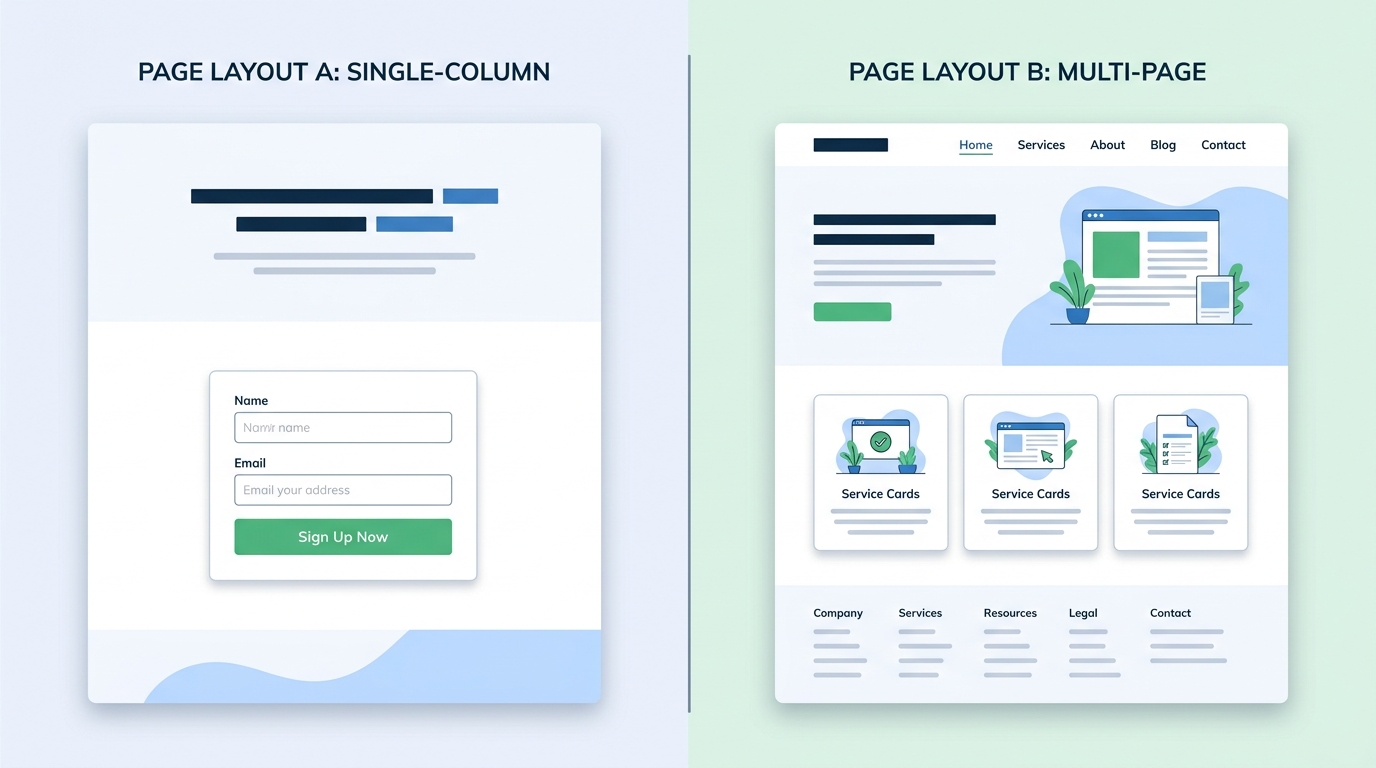
A landing page is a single, focused URL with one job: get a visitor who already showed up with intent (usually from an ad, an email, or a QR code) to take one specific action. Book a call, download a guide, start a trial. No top nav. No footer with 30 links. One offer, one form, one reason to be there.
A full website is a multi-page property — homepage, services, about, blog, contact, sometimes more — that serves multiple audiences at different stages: cold organic visitors finding you on Google, repeat customers checking hours, journalists looking for press info, your existing clients hunting for a phone number.
The mistake most owners make is treating these as interchangeable. They're not. They have different jobs, different metrics, different costs, and different lifespans.
Citation: Unbounce's 2025 conversion benchmark report analyzed 41,000 landing pages with 464 million visitors and found a median conversion rate of 6.6%, compared to the 2–5% range that typifies general business homepages tracked by Lucky Orange. Source: Lucky Orange Industry Benchmarks, 2025.
How Much Does Each One Actually Cost?
This is where most owners get blindsided. The headline numbers from agencies hide the real spread.
Landing Page Costs (2026)
- DIY on a builder (Carrd, Unbounce, Leadpages, Framer): $0–$99/month, ready in an afternoon
- Freelancer-built: $300–$1,500 per page (Landingi, 2025)
- Agency-built: $1,000–$5,000 per page, usually with copywriting and tracking included
A landing page is small surface area. You can launch one in a weekend, run paid traffic at it next Monday, and have hard data on whether it works by the end of week two.
Full Website Costs (2026)
- DIY on a platform (Squarespace, Wix, WordPress + theme): $200–$1,500 for the year, plus your time
- Freelancer-built small business site: $2,000–$10,000 for 5–10 pages
- Agency-built: $5,000–$50,000+ depending on integrations, design system, and content migration (Digital Present, 2025)
A full website is bigger surface area, more decisions, more content. Even a "small" site usually takes 4–8 weeks to do properly. And the launch is just the beginning — multi-page sites need ongoing SEO, content, and updates to actually work.
When Does a Landing Page Win?
Choose a landing page first when traffic is paid, the offer is specific, and you need data fast.
You're Running Paid Ads
Google Ads, Meta ads, LinkedIn ads — every dollar you spend deserves a landing page, not a homepage. A homepage gives a paid visitor 17 things to click. A landing page gives them one. That's why landing pages convert at 6.6% median while homepages limp along at 2–5%.
Citation: Email-driven landing pages convert at an average 19.3%, and webinar landing pages hit 22.3% in Unbounce's 2025 benchmark study — both far above any homepage benchmark. Source: SEO Sherpa Landing Page Statistics, 2026.
You're Validating a New Offer
Before you pour weeks into a full site rebuild around a new service, build a landing page. Run $500 of traffic at it. If it converts, you have a real offer. If it doesn't, you saved yourself the rebuild.
I do this with almost every Los Cabos client testing a new package — bilingual concierge, monthly retainer, AI voice agent setup. Landing page first, full service page on the website only after the offer is validated.
You Need a Page That Matches an Ad
Google's Quality Score and Meta's relevance score both reward message match — the headline on the ad matches the headline on the page. You can't do that with a homepage. You can do that with a landing page in 20 minutes.
You're Running an Event, Promo, or Limited Offer
Black Friday sale. Seasonal package. Webinar registration. None of these belong on your permanent navigation — but they all need a high-converting URL you can spin up and tear down.
When Does a Full Website Win?
Choose a full website first when traffic is organic, the buyer journey is researched, and you need authority that compounds.
You Depend on Google Search for Leads
This is the big one. A single-page site can't compete in organic search. You need separate pages for separate keywords — one URL targeting "AI consultant Los Cabos," a different URL for "n8n automation consultant," another for "bilingual website design."
Citation: Single-page sites flatten internal linking, leaving Google's crawler nowhere to go. Real estate agents who launched single-page sites in 2025 reported zero local search visibility despite professional design. Source: Wix Multi-Page vs Single-Page SEO, 2025.
If you've been wondering why your beautiful one-pager doesn't show up on Google, this is the reason. There's nothing for Google to rank except the homepage, and that homepage is fighting for keywords against companies with 50 dedicated pages each. The same logic applies for local SEO in Los Cabos — every neighborhood and service deserves its own page.
You Sell Multiple Services at Different Price Points
A consultant who does $5K websites AND $30K AI integrations needs separate pages for each. Visitors on different journeys need different proof, different testimonials, different CTAs. Cramming everything into one page makes none of them convert.
You Want to Publish Content (Blog, Case Studies, Resources)
Content marketing requires a content-shaped site. You need a blog index, individual post URLs, category pages, internal linking. None of that exists on a single landing page. If your strategy is "be the expert who shows up in Google results," you're building a multi-page site.
Your Buyers Research Heavily Before Buying
In hospitality, real estate, healthcare, and B2B services, prospects look at 5–10 pages before they reach out. They want to see your team, your process, your past work, your pricing logic. A single page can't do that work — and trying to cram it all into one page creates a 6,000-word scrolling monster nobody reads.
What About the "Hybrid" Setup Most Growing Businesses Need?
For 80% of the small businesses I work with — restaurants, vacation rentals, service companies, consultants — the right answer isn't one or the other. It's both, used for different jobs.
The hybrid stack:
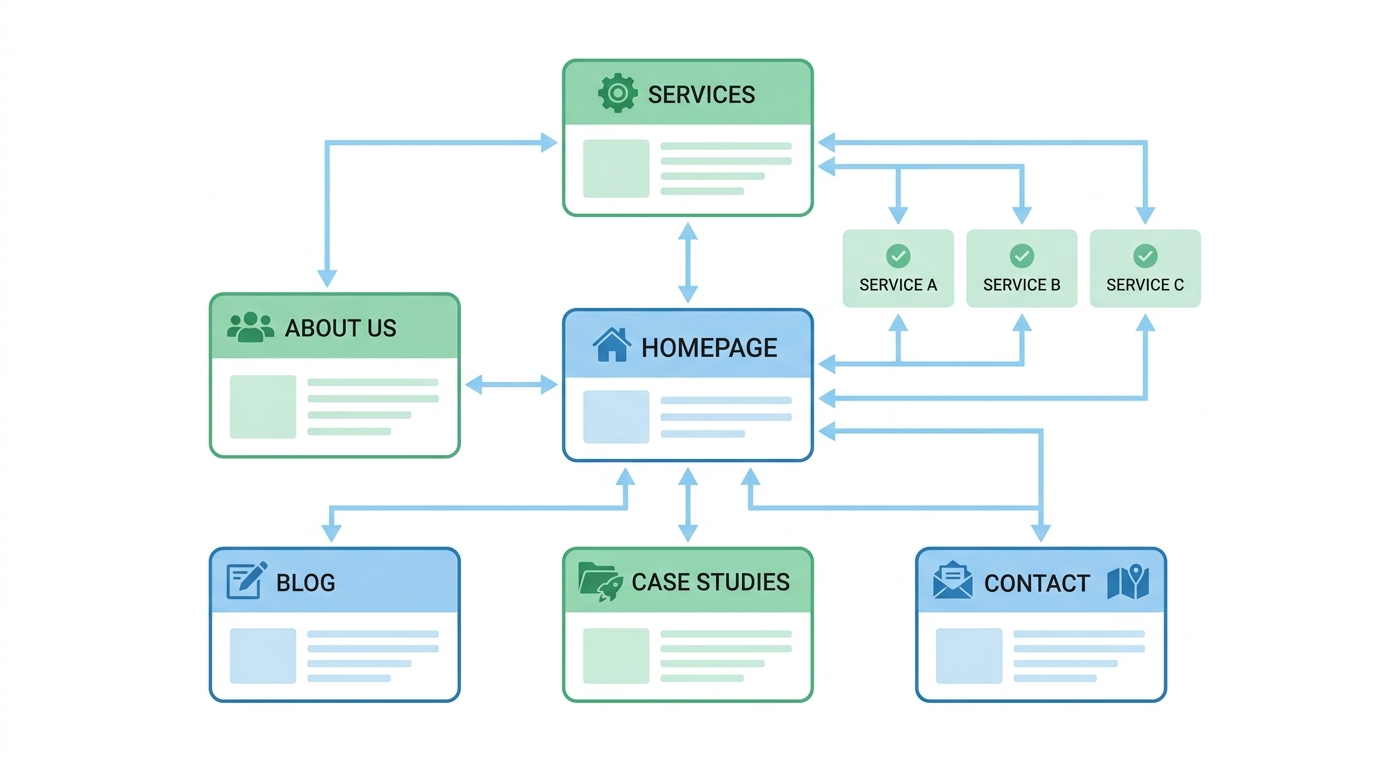
- A real multi-page website (5–8 pages: homepage, services, about, contact, blog) optimized for organic SEO — slow but compounding traffic
- One or more dedicated landing pages for every paid traffic source or specific offer — fast feedback, high conversion
- Shared brand assets (logo, colors, photography, voice) across both so visitors don't notice the difference
A Cabo tour operator I helped this year runs exactly this setup: a 7-page site that ranks for organic searches like "sunset cruise Cabo San Lucas," plus a separate landing page they point Meta ads at for their bachelorette package. The website brings in 40% of leads at $0 cost per lead. The landing page converts paid traffic at 8.4% — more than triple what they were getting when they pointed ads at the homepage.
If you're already running ads to your homepage, switching to a dedicated landing page is usually the fastest single conversion win you can get. It's also where I'd add AI lead capture tools first — landing pages have less competing UI, so chatbots and smart forms perform noticeably better there than on busy homepages.
How Many Pages Should a Small Business Website Actually Have?
Five to eight is the sweet spot for most small businesses. More than that and content goes stale. Fewer and you can't target enough keywords or answer enough buyer questions.
A solid 7-page small business site looks like:
- Homepage — clear value prop, social proof, primary CTA
- Services (or one page per service if you have 2–4 distinct offerings)
- About / Team — the human story behind the business
- Case Studies / Portfolio — proof you've done this before
- Blog / Resources — content that ranks and demonstrates expertise
- Contact — location, hours, form, phone, map
- Pricing or Process — answering the question every buyer asks before reaching out
Skip the FAQ-as-its-own-page. Bake the FAQ into your services and pricing pages where it belongs. Skip the "Our Values" page. Nobody clicks it. Skip a "Careers" page until you're actually hiring.
Decision Framework: Which One Should You Build First?
| Your Situation | Build First | Why |
|---|---|---|
| Running paid ads next month | Landing page | Every $1 of ad spend deserves a focused page |
| Depending on Google for leads | Full website | Single-page sites can't rank competitive keywords |
| Validating a new offer | Landing page | Cheap, fast, real data in 2 weeks |
| Hiring + scaling on word-of-mouth | Full website | Buyers research; you need depth |
| One promo or event | Landing page | Build, run, retire — don't pollute permanent nav |
| Multiple services, multiple audiences | Full website | Each audience needs its own page |
| Already have ads running to homepage | Landing page | Fastest single conversion win available |
| Competing for local SEO (Cabo, LA, etc.) | Full website | Local keywords need dedicated pages per service area |
FAQ
Can a single landing page replace a full website for a brand-new business?
Short term, yes — if all your traffic is paid or referral and you don't need Google search. I've watched solo consultants run a Carrd page for 18 months while they figured out what they actually sell. But the moment you want organic traffic, repeat customers checking hours, or content that compounds, you'll outgrow it. Plan for that transition rather than rebuilding from scratch.
How long does it take to build each one?
A focused landing page on a builder (Carrd, Framer, Unbounce) takes 4–8 hours including copy. A custom-built freelance landing page is usually 1–2 weeks. A 7-page small business website built well is 4–8 weeks. Don't trust anyone quoting a 1-week full website — they're either reusing a template you'll regret or skipping the strategy work that makes it actually convert.
Do landing pages hurt SEO?
A standalone landing page (separate domain or subdomain) doesn't hurt your main site's SEO at all. A landing page on your main domain that's only linked from ads — same thing, no penalty. The myth that landing pages "hurt SEO" usually comes from people who built thin, duplicate landing pages and indexed all of them. Use noindex on paid-traffic landing pages and you're fine.
What about ChatGPT, Perplexity, and AI search — does any of this matter for AI citations?
Yes, and the answer favors multi-page sites. AI assistants pull citations from sites with depth, structure, and authority — exactly what 5–8 pages of well-written content provides and what a single landing page can't. If showing up in AI Overviews and ChatGPT matters to your business, you need a real website.
Should I build the landing page myself or hire someone?
Build it yourself if you're under $500/month in ad spend and the offer is simple. Hire someone if you're spending $2,000+/month on ads — at that volume, a 1-point conversion improvement easily pays a $1,500 build fee inside the first month. The break-even math almost always favors paying for help once you're running real budget.
My agency wants $15,000 for a 5-page website. Is that fair?
Depends what's included. $15K should buy you strategy + custom design + custom development + copywriting + photography + SEO setup + analytics + a launch plan. If you're getting a templated site with stock photos, $15K is too high. A fair freelance price for a custom 5-page small business site is $3,000–$8,000. Ask for a line-item breakdown — any agency that won't provide one is hiding the markup.
The honest answer is that landing pages and websites are tools, not religions. Pick the one that matches the job in front of you. If you're spending money on ads, build the landing page. If you're depending on Google to bring you clients, build the full site. If you're growing, you'll need both eventually — and the ones who win are the ones who stop treating that as a problem to solve and start treating it as the obvious shape of a real business online.
Want a second opinion on what to build next? I'll review your current setup, your traffic sources, and your goals, and tell you exactly which one to build first — landing page, full site, or both. No pitch, just a clear plan.