Local SEO Los Cabos: Outrank TripAdvisor in 2026 (No Fluff)
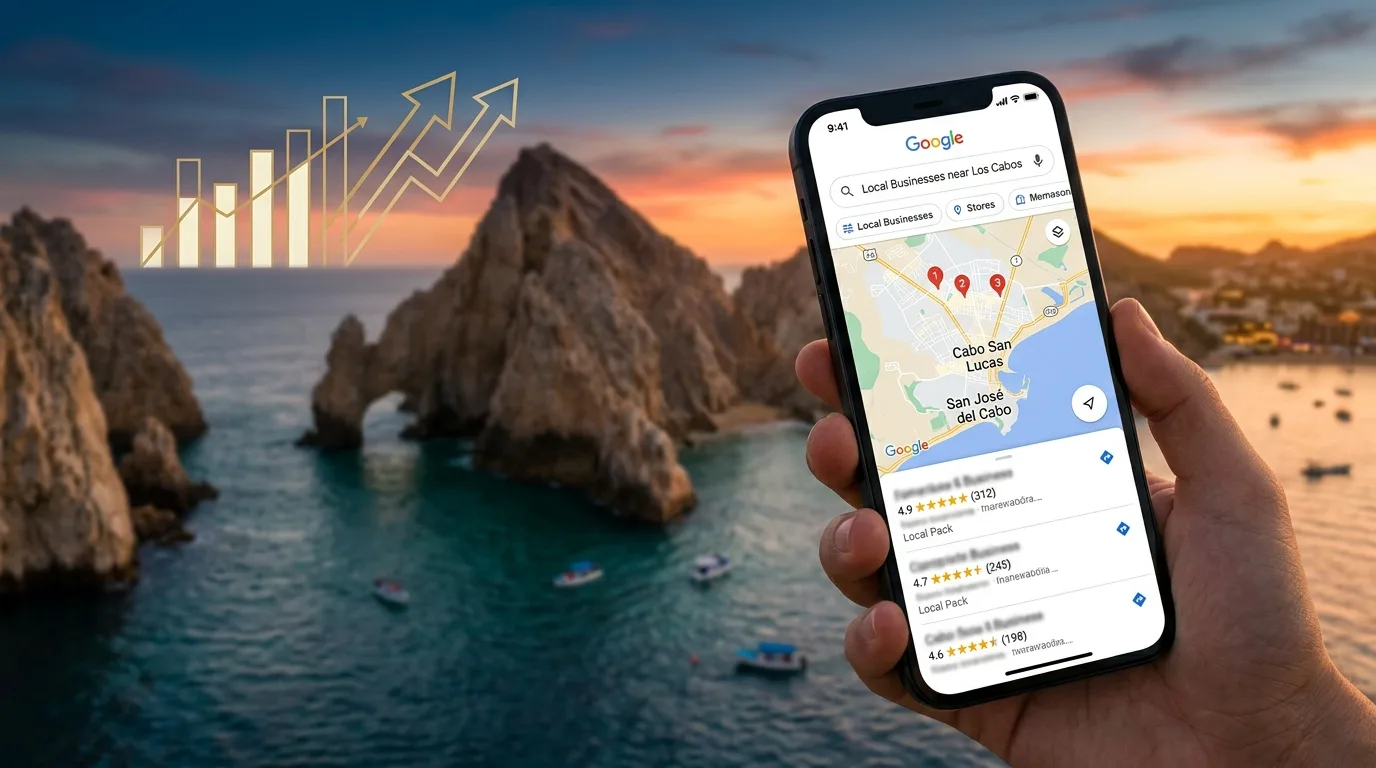
Los Cabos hosted 4.13 million tourists in 2025 with 67.9% arriving from outside Mexico (FITURCA Los Cabos Observatory, April 2025). Almost every one of those visitors typed a question into Google before they booked: "best taco stand in Cabo," "couples massage San José del Cabo," "private fishing charter Cabo San Lucas." If your business isn't in the top 3 of the Google map pack for those searches, you're effectively paying Booking.com, TripAdvisor, and Expedia 15–25% commission to introduce you to customers Google could have sent you for free.
The good news: Los Cabos is one of the easiest local SEO markets in the world. There's almost no organized local SEO competition. Most hotels, restaurants, and tour operators in Cabo have abandoned Google Business Profile, list inconsistent addresses across the web, ignore reviews for weeks at a time, and publish zero content that actually targets the questions tourists ask. The aggregators rank because nobody else is showing up.
Here's the playbook that pulls bookings away from those aggregators and lands them on your own site, your own phone line, and your own WhatsApp — what works for Cabo businesses in 2026, what's a waste of money, and a 30-day action plan. It's the local-search chapter inside Why Your Small Business Website Loses Leads, which maps the 6 places small business sites quietly underperform.
Key Takeaways
- The top 3 Google map pack results get 126% more traffic and 93% more calls than businesses ranked 4–10 (BrightLocal, 2025)
- 80% of US consumers search online for local businesses weekly, 32% daily — and 62% will avoid a business if they find incorrect info online (BrightLocal, 2025)
- "Near me" searches have grown 900% in two years; 82% of smartphone shoppers run "near me" searches (Go-Globe, 2025)
- Booking.com takes 10–25% commission (15% average); TripAdvisor base commission starts at 10% (PriceLabs, Mirai, 2025)
- Most Cabo competitors aren't doing local SEO at all — Google Business Profile, citation consistency, and review velocity beat the aggregators in 90 days
Why Local SEO Matters More in Cabo Than Almost Any Other Market
Los Cabos is a destination market. Visitors don't have a default "their usual restaurant" — every meal, every excursion, every spa treatment is researched fresh in a 30-second mobile search after they land at SJD. That research is hosted almost entirely on Google: Maps, the local pack, Search, and increasingly AI Overviews powered by the same local data. If your business isn't surfaced in those moments, you don't exist — and even if you are, a slow desktop-first site loses half its visitors before the page renders, which is why mobile-first web design is the foundation every other local SEO investment sits on top of.
Two structural realities make Cabo's local SEO opportunity unusually large.
First, the aggregator tax is brutal. Booking.com commissions run 10–25% with a global average around 15% (PriceLabs, 2025). On a $400/night room with 70% occupancy, that's roughly $30,000/year in commission per room. A property with 20 rooms is paying half a million dollars a year for traffic Google would happily send for free if the property ranked.
Second, the competition is asleep. I audit Cabo businesses every week. Most have an unclaimed or abandoned Google Business Profile, no schema markup on their website, addresses that don't match between Google, Facebook, and TripAdvisor, and review response rates under 20%. Outranking them isn't an SEO arms race — it's showing up.
The local pack itself is where almost all the action happens. Top-3 map pack businesses get 126% more traffic and 93% more calls than businesses ranked 4–10 (BrightLocal, 2025). Forty-two percent of clicks on local-intent searches go to the map pack itself, before anyone even scrolls to organic results. If you only fix one thing this year, fix the map pack.
The Local SEO Stack: 5 Things That Actually Move Rankings
Local SEO advice on the internet is mostly inflated. The actual ranking factors that move the needle for a Cabo business are concentrated in five areas. Everything else is rounding error.
1. Google Business Profile (the foundation)
Your Google Business Profile is the single most important local ranking asset, period. Treat it as a living product, not a setup-once asset. The deep-dive on this section lives in the Google Business Profile playbook for Los Cabos businesses, which walks through the 7 fixes most Cabo profiles miss.
What actually matters:
- Primary category accuracy. "Mexican Restaurant" and "Seafood Restaurant" are different rankings. Pick the one that matches your dominant search intent and add 4–6 secondary categories.
- Service area and address. A physical location is a major trust signal in Cabo — set the precise address with map pin verification. Service-area businesses (private chefs, photographers, transport) should set service zones, not addresses.
- Photos updated weekly. Profiles with regular photo uploads get measurably more views. Two new photos a week from your phone is enough.
- Google Posts. Most Cabo businesses ignore them. They're free real estate that appears in your knowledge panel — use them for events, specials, and seasonal content.
- Q&A. Seed your own profile with the 10 questions guests actually ask: parking, dress code, kids welcome, vegetarian options, English-speaking staff. If you don't answer them, a competitor or a confused tourist will.
- Bilingual descriptions. Cabo is a bilingual market. Your description should naturally include both English and Spanish keywords without keyword-stuffing.
2. NAP citation consistency
NAP = Name, Address, Phone. Sixty-two percent of consumers will avoid a business if they find incorrect info online (BrightLocal, 2025) — and Google sees inconsistency as low trust.
Audit the obvious citation sources for your business:
- Google Business Profile
- Facebook page
- Instagram bio
- TripAdvisor / Yelp listings
- Local directories: Cabo Magazine, Gringo Gazette, Destino, FITURCA listings
- Your own website (footer + schema markup)
Every one of these should have identical business name, address (street/colonia/CP/state/country), and phone number. "Av. Lázaro Cárdenas 100" and "Avenida Lazaro Cardenas #100" are different to Google. Pick one canonical format and propagate it everywhere.
3. Local content with real geographic intent
Most Cabo business websites have an "About" page, a "Menu" or "Services" page, and a "Contact" page. That's it. Google has nothing to rank you for beyond your business name.
Local content that ranks:
- Neighborhood pages: "[Business Type] in San José del Cabo," "[Business Type] in the Marina," "[Business Type] in Pedregal"
- Question-based pages targeting actual searches: "Is Cabo San Lucas safe for families?", "What time should you make dinner reservations in Cabo?", "Best month to fish for marlin in Cabo"
- Bilingual content. Half your tourist audience is now bilingual or Spanish-first travelers. Spanish-language pages are nearly uncontested in Cabo's restaurant and tour categories.
The pattern is the same one I detail in the bilingual AI consulting piece — most local competitors write English-first or Spanish-first, and the businesses that publish well-written content in both win the long tail.
4. Reviews — quantity, recency, and response rate
Reviews are a top-3 local pack ranking factor. The math is unforgiving:
- Quantity. A property with 80 reviews loses to one with 400 if the ratings are similar.
- Recency. Reviews older than 12 months are heavily discounted. You need a steady inflow.
- Response rate. Properties that respond to 100% of reviews — positive and negative — outrank profiles with 20% response rate even at the same review count.
Most Cabo businesses are leaving 80% of guests un-asked for reviews. A simple WhatsApp message 24 hours after checkout or after the meal — language-matched, with a direct link to your Google review form — typically converts 25–40% of guests into leaving a review. That's the difference between 15 reviews a year and 200.
For the system that handles drafting and responding at scale (without sounding like a robot), see our breakdown of AI-powered review management for hospitality businesses.
5. Local backlinks (the underrated lever)
Local backlinks — links from Cabo-relevant websites — are the single hardest ranking factor for aggregators to compete on, because aggregators don't get them. Every TripAdvisor and Booking.com page is templated and linked from generic global authority. They have almost zero local link equity.
Where Cabo businesses can get real local backlinks:
- Local press: Gringo Gazette, Destino, El Sudcaliforniano feature articles
- Tourism boards: FITURCA listings and partnerships
- Local blogs and influencers: Cabo lifestyle blogs, expat forums, Instagram travel creators with linked websites
- Vendor cross-links: your photographer, your wedding planner, your charter partner — every collaboration is a backlink opportunity
- Chamber of commerce: CANIRAC for restaurants, CANACO for general business, AMHM for hotels
Five high-quality local backlinks will move a Cabo business in the SERP more than 50 generic directory submissions.
Bilingual SEO: The Cabo-Specific Multiplier
Most US-based SEO agencies pitching Cabo businesses run English-only campaigns. They're leaving half the search market on the table.
Mexican domestic tourism to Los Cabos has grown faster than international arrivals over the past three years. Spanish-speaking travelers from Mexico City, Guadalajara, and Monterrey search in Spanish for "mejor restaurante Cabo San Lucas," "tour de pesca Los Cabos," "spa para parejas San José del Cabo." Those searches are nearly uncontested in the SERP.
Building a bilingual SEO setup in Cabo:
- Separate URL structure. Use
/es/subdirectories for Spanish pages, not auto-translation widgets. Google treats translated pages as duplicate content if they're not properly tagged. hreflangtags. Every page should declare its language pair so Google knows to surface the Spanish version to Spanish-speaking searchers.- Spanish-native content, not translation. Spanish content written from scratch by a bilingual writer outperforms machine-translated English. Mexican Spanish, specifically — not Castilian or neutral Latin American Spanish.
- Bilingual reviews and Q&A. Encourage reviews in both languages. They count, and they signal language relevance to Google.
This is the same architecture I've used to ship sites for clients across the Cabo hospitality market — it's the single highest-leverage move most Cabo businesses still haven't made.
Beating the Aggregators: How a Single Cabo Restaurant Outranks TripAdvisor
A seafood restaurant client in Cabo's Marina was sitting at position 6 in the local pack for "seafood Cabo San Lucas" and getting most of their reservations through OpenTable and TripAdvisor. Both platforms charge 5–10% on reservations and limit guest data they share back. The owner wanted direct bookings.
What we did over 90 days, in order:
- Google Business Profile audit and overhaul. Re-categorized as "Seafood Restaurant" (primary) + 5 secondaries. Updated 47 photos. Wrote bilingual descriptions. Seeded 18 Q&As.
- NAP cleanup across 14 citation sources. Consolidated to one address format. Fixed three sites listing an old phone number.
- Eight local content pages. Six neighborhood pages ("seafood near Marina," "seafood near Médano Beach," etc.) and two question pages ("when to eat seafood in Cabo," "best seafood restaurants for families").
- Review velocity. Set up a WhatsApp prompt to every guest 90 minutes after their bill. Went from 4 reviews/month to 38/month. Responded to 100% in the matched language within 24 hours.
- Local backlinks. Three Gringo Gazette features, one Destino piece, four cross-links from wedding planners and concierge desks.
Ninety days later: position 1 in the local pack for the primary keyword, 2x direct bookings, OpenTable share dropped from 60% of reservations to 30%, and the restaurant's own no-show automation caught the rest. The aggregators didn't get worse — the restaurant just made itself impossible to skip.
The 5 Local SEO Mistakes Cabo Businesses Keep Making
Recurring patterns I see in audits, ranked by how much they cost the business:
- Unclaimed or stale Google Business Profile. No primary category, no posts in 18 months, photos from 2019. The fastest fix on this list and the highest-impact.
- Inconsistent address format. Three different versions of the same street address across Google, Facebook, and TripAdvisor. Quietly tanks trust signals.
- Zero review responses. A 5-star review with no response is a signal that nobody's home. A 1-star review with no response is a signal that nobody cares.
- English-only website. Half your search demand is Spanish. You're handing it to whoever bothers to publish a Spanish page first.
- Hosting your menu/rates as a PDF. Google can't rank a PDF as well as an HTML page. Every PDF menu is a reservation Google sent to a competitor.
- A site that takes 6+ seconds to load on mobile. A perfect Google Business Profile pointing to a slow website undoes most of the work — the 2026 page speed benchmarks show 53% of users abandon at 3 seconds, and Cabo competitors averaging 6–8 seconds is exactly the gap to exploit.
For the broader pattern of where small businesses leave money on the floor with AI and digital infrastructure, see common AI automation mistakes small businesses make.
Your 30-Day Local SEO Action Plan
A realistic plan for a single owner-operator or marketing manager. About 6–8 hours of work spread across the month.
Week 1 — Foundation
- Claim and audit Google Business Profile (categories, hours, address, phone)
- Upload 20 fresh photos (from your phone is fine)
- Write bilingual description, add 10 Q&As
- Document your canonical NAP format
Week 2 — Citation cleanup
- Audit 10 most important citation sources for NAP consistency
- Fix mismatches (Google, Facebook, Instagram, TripAdvisor, Yelp, local directories)
- Add LocalBusiness schema markup to your website footer/contact page
Week 3 — Content
- Publish 2 neighborhood pages (where you're located + one nearby area)
- Publish 1 question-based page (a common tourist question relevant to your business)
- Start a Spanish version of your home page if English-only
Week 4 — Reviews and backlinks
- Set up post-visit review request (WhatsApp or email, language-matched)
- Reach out to 3 local press / blog targets for a feature
- Cross-link with 2 vendor/partner businesses
- Schedule monthly Google Business Profile post cadence
If you do nothing else for the rest of the year except keep Week 4 going (reviews + backlinks + posts), you'll outrank most of your local competition and put real pressure on the aggregators.
Frequently Asked Questions
How long does local SEO take to work in Los Cabos? You'll see Google Business Profile improvements within 2–4 weeks. Map pack ranking changes typically show in 60–90 days. Organic content pages can take 3–6 months to rank competitively. Cabo is less competitive than US markets, so timelines are faster than you'd see in Los Angeles or Miami.
Should I run Google Ads instead of investing in local SEO? Run both, but treat them differently. Google Ads buys you the top of the SERP today; local SEO compounds and pays you back for years. For Cabo hospitality specifically, the map pack is more valuable than text ads — it's where 42% of local clicks go.
What's the cheapest way to get more Google reviews? A WhatsApp template message 60–90 minutes after the guest has eaten or checked out, with a direct one-tap link to your Google review form. Conversion rates are 25–40%. No third-party review platform fee, no tablet at the front desk that nobody uses.
Do I need a separate website for English and Spanish?
No — one website with /es/ subdirectories and proper hreflang tags performs best. Separate domains split your authority and make analytics painful.
How do I outrank TripAdvisor and Booking.com? You don't outrank them on every keyword — they have global authority. You outrank them on the local pack (where they don't appear) and on long-tail bilingual queries (where their templated pages can't compete). That's where 80%+ of high-intent Cabo bookings happen.
Is local SEO worth it for a service-area business (private chef, photographer, charter)? Yes — set Google Business Profile to service-area mode (no public address), define your service zones, and focus on review velocity and local backlinks. Service-area businesses are some of the best ROI in Cabo because the aggregators barely cover them.
The Bottom Line
Local SEO in Los Cabos isn't an arms race. It's a checklist that almost no one is running. A claimed Google Business Profile, consistent citations, bilingual content, a reliable review request, and five real local backlinks will put most Cabo businesses ahead of every aggregator-dependent competitor in their category within a quarter.
The hardest part isn't the work — it's deciding to stop paying the 15% commission tax and start building an asset you actually own.
If you'd like a free Google Business Profile + citation audit for your Cabo business, book a 30-minute discovery call and I'll walk you through where your local SEO stands today.