Slow Season AI for Cabo Tourism: 2026 Off-Peak Playbook
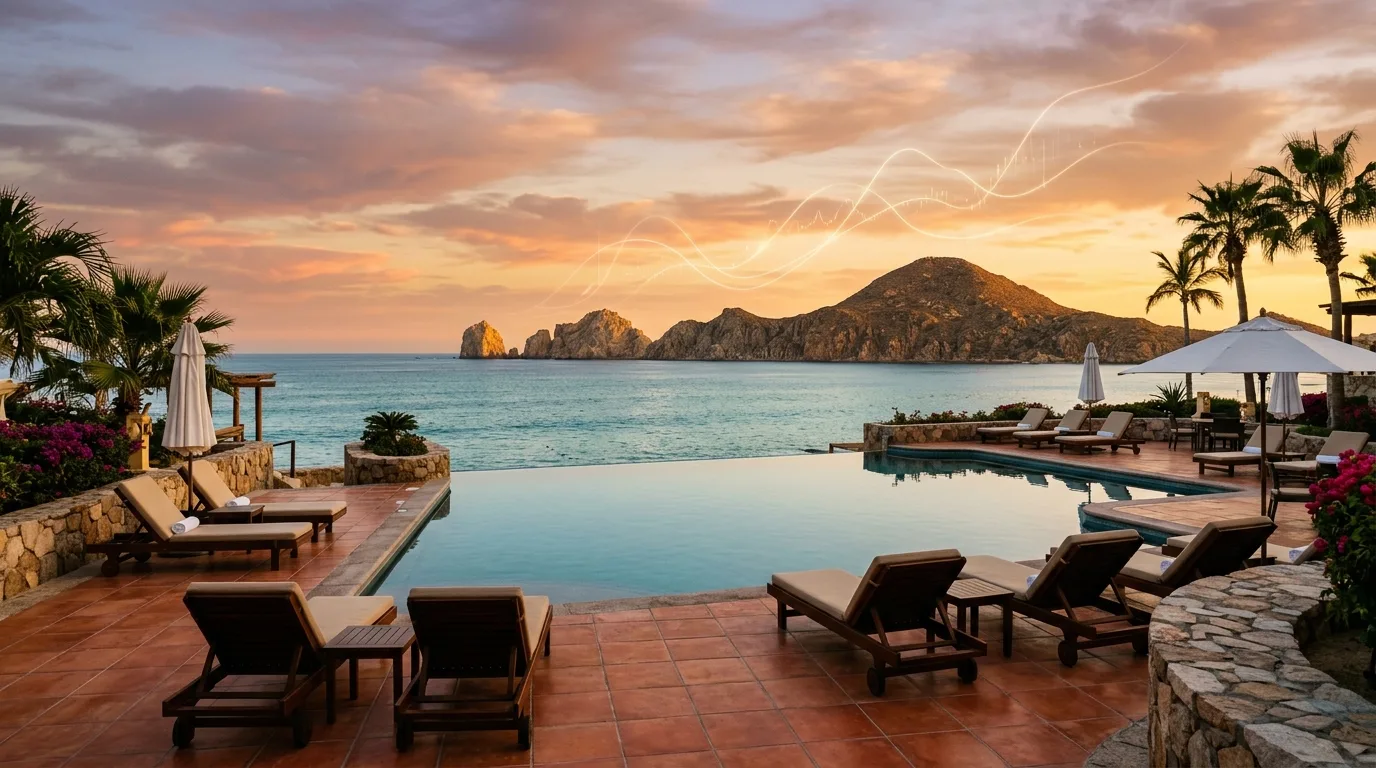
Ask any Cabo hotelier, charter captain, or restaurant owner about the calendar and you'll hear the same story. November through April: full bookings, two-week wait lists, ADR pushed to peak. Then September arrives — hurricane warnings, 95-degree heat, and an Instagram feed full of empty pool decks.
Los Cabos hotels averaged 81.5% occupancy from January to March 2025 (FITURCA Observatory, 2025), but September 2025 came in around 47% (Los Cabos Hotel Association via Gringo Gazette, 2026), and room rates fall in the same window. For a boutique hotel, that's a revenue gap that no amount of "we always survive it" optimism actually covers.
This is exactly the gap AI was built for. Dynamic pricing engines, demand forecasting models, multilingual ad automation, and win-back campaigns aren't luxury bolt-ons — they're the four levers that help fill a low-occupancy month without dropping rate to the floor. This post breaks down what each one actually does, how to judge results, and what it costs to deploy in 2026. It's the seasonal-strategy chapter inside the AI for Hotels, Restaurants & Tourism: 2026 Playbook.
Key Takeaways
- Cabo occupancy swings from about 81% in January–March 2025 (FITURCA, 2025) to about 47% in September 2025 (Gringo Gazette, 2026), and rates drop at the same time
- AI revenue management systems reprice every room-night against live demand, and that matters most in shoulder and low season
- Win-back campaigns to past guests are usually the cheapest bookings you can get in a slow month
- Demand forecasting that blends weather, events and search trends beats last-year-same-week guessing for staffing
- Total slow-season AI stack runs roughly $300–$1,200/month for a small Cabo operator
Why Cabo's Slow Season Is Worse Than Most Operators Admit
The standard line in Los Cabos is "September is just one bad month." The data tells a different story.
Los Cabos welcomed a record 3.77 million visitors in 2025 (Gringo Gazette, March 2026), but those visitors are wildly unevenly distributed. The FITURCA Los Cabos Tourism Observatory (2025) put January–March 2025 hotel occupancy at 81.5%, with March at 84%. The Los Cabos Hotel Association put September 2025 at roughly 47% and August 2026 at about 56%, and calls September historically the lowest month (Gringo Gazette, 2026).
The revenue impact is steeper than the occupancy curve suggests because ADR compresses at the same time occupancy drops. Illustrative example: a room that books for $400/night in February and $260 in September has lost 35% of its rate. Combine that with occupancy falling from 80% to 50%, and revenue per available room falls by roughly 60%, far more than the booking calendar alone implies.
Three structural reasons make this worse for Cabo than for, say, Cancún or Puerto Vallarta:
- US-heavy guest mix — a large share of Cabo visitors arrive on international flights, mostly from the US. When US travelers pivot to Europe in summer, Cabo doesn't have a domestic base big enough to fill the gap.
- Hurricane season risk premium — Aug–Oct insurance and cancellation friction discourages last-minute bookings even on perfect-weather weeks.
- Heat barrier — Outdoor activities (golf, fishing, snorkeling) face genuine comfort limits, narrowing the appeal to guests who specifically want indoor luxury or A/C-heavy itineraries.
This is not a marketing problem you fix by posting more reels. It's a demand-shaping problem — you need to find specific guest segments who actually want what Cabo offers in low season (heat-tolerant adventurers, digital nomads, off-peak deal hunters, Mexican domestic travelers) and route them to the right inventory at the right price. That's exactly what AI does well.
Lever 1: Dynamic Pricing AI — The Single Highest-ROI Slow Season Tool
If you only deploy one AI tool for slow season, this is it.
Traditional revenue management in Cabo still runs on Excel spreadsheets and gut feel — a manager looks at last year's September, drops rate 25%, and prays. AI revenue management systems (RMS) like IDeaS, Atomize, and Duetto ingest a wide range of signals — competitor pricing, search demand, lead time, day-of-week patterns, weather forecasts, flight inventory — and recompute rates continuously.
The case for an AI-driven RMS is strongest when demand is thin: a flat discount gives away rate on nights that would have sold anyway, and still fails to fill the nights that wouldn't.
The mechanism is straightforward: instead of a flat 25% September discount, AI prices each room/night individually. Illustrative example: a poolside suite booked 14 days out by a Mexican family on Friday night might price at $340 (only 5% off peak). A garden-view king booked 2 days out by a single business traveler might price at $179 (47% off peak). The total revenue across both bookings beats a flat-rate world because AI captures the willingness-to-pay variance instead of averaging across it.
For Cabo operators, the practical playbook:
- Hotels with 20+ rooms: full RMS subscription ($400–$1,200/month for properties this size)
- Vacation rental managers: PriceLabs or Beyond ($30–$60/listing/month)
- Tour & charter operators: dynamic pricing inside FareHarbor or Bokun using their built-in demand multipliers (no extra cost — many operators just leave it disabled)
For more on automating restaurant-side revenue plays during slow times, see How Restaurants Use AI to Reduce No-Shows — the same booking confirmation flow doubles as a slow-season demand smoother.
Lever 2: Demand Forecasting — Stop Staffing for the Wrong Day
The biggest cash leak in Cabo low season isn't unsold inventory — it's operating cost mismatched to actual demand. A restaurant staffed for 90 covers that does 42 burns labor margin. A spa with 6 therapists scheduled for a 2-massage day burns even more.
Traditional forecasting in hospitality uses last-year-same-week or 4-week-rolling-average baselines. AI demand forecasting models add the signals those baselines ignore: weather, local events, competitor pricing, flight load factors, and Google Trends search velocity.
Better forecasts translate directly into labor savings. Illustrative example: a restaurant whose forecast (weather, Google Trends searches for "Cabo restaurants," local tour booking density) shows a slow Tuesday and a busy Friday can move 2 Tuesday shifts to Friday. At $50 per shift, that's $100 a week, or about $400 a month, no longer spent staffing an empty room.
The pattern works for:
- Restaurant cover counts (most ROI for venues with 60+ seats)
- Spa & treatment booking forecasts (drives therapist scheduling)
- Charter and tour load forecasts (drives crew, fuel, and supply pre-buys)
- Hotel arrival forecasts (drives front-desk and housekeeping shift sizing)
For most small operators, this doesn't need a dedicated SaaS tool. A weekly Make.com workflow that pulls 4–5 demand signals into a Google Sheet, runs them through GPT-4 with last year's same-week as a sanity check, and emails Monday morning forecasts to the GM costs $50–$120/month to build and run. See n8n for Restaurant Operations: 6 Workflows That Pay for Themselves for the technical pattern.
Lever 3: Multilingual Ad Automation — Pull the Right Off-Season Guest
In high season, Cabo doesn't really need to advertise — return guests, OTAs, and word-of-mouth fill the calendar. In low season, paid acquisition becomes a real lever on occupancy, and the segments worth targeting are dramatically different from peak.
Slow-season Cabo guests skew toward:
- Mexican domestic travelers (Guadalajara, Monterrey, Mexico City — heat-tolerant, drive/short-haul flight)
- Latin American short-hauls (Brazilian, Argentinian, Colombian travelers fleeing southern hemisphere winter)
- Heat-comfortable US niches (Phoenix, Las Vegas, Miami residents — already used to August heat)
- Digital nomads and remote workers booking 2–3 week stays
Each of these segments speaks a different language, runs on a different platform mix (Mexicans skew Facebook + WhatsApp, US heat-tolerant skew Instagram, nomads skew TikTok and Twitter), and responds to a different value prop (price for one, work-from-anywhere for another).
Manually running 8–12 ad variants across 4 platforms in 2 languages is what kills off-season marketing programs. AI ad automation tools — Smartly.io, AdCreative.ai, and increasingly Meta Advantage+ — auto-generate creative variants, translate copy with brand voice retention, and reallocate budget toward winners hourly.
The payoff is testing more variants than a person could manage by hand. For bilingual operators, language quality matters even more — see Bilingual AI Consulting for Mexican Hospitality: What Actually Works for why language quality matters so much in bilingual guest-facing AI.
Practical setup for a Cabo property in 2026:
- Meta Advantage+ Shopping or Lead Gen with 6–8 creative variants generated by AdCreative.ai (~$40/mo)
- GPT-4 + DeepL pipeline to maintain Spanish/English brand voice consistency (~$30/mo API)
- Geo-targeted budget routing to Mexican source cities for the late-summer window
- Total monthly tool cost: roughly $70–$150 layered on top of ad spend
Lever 4: Win-Back Campaigns — Your Past Guest List Is the Asset
The single most under-used asset in Cabo hospitality is the list of guests who already paid you money in the last 24 months. Most properties send a one-shot "miss us?" email in May and consider the job done.
Past guests already know the property, so a well-built win-back sequence reaches people far warmer than any cold prospecting audience, and every booking it lands costs no ad spend.
AI win-back automation goes beyond a single email blast. A practical pattern for Cabo properties in 2026:
- Segment past guests by stay window, party type, and spend tier (GPT-4 over a CRM export does this in under an hour)
- Generate personalized offers — a family that came in March 2024 gets a different message than a couple who came for a wedding in November 2023
- Trigger sequences based on behavior — opens but doesn't book → secondary offer at day 7; books → upsell pre-arrival sequence
- Multi-channel — email + SMS + WhatsApp Business for Mexican past guests
Tool stack for a 5,000-guest list:
- Klaviyo or Mailerlite ($50–$150/mo)
- Twilio or WhatsApp Business API ($30–$80/mo)
- Make.com to orchestrate ($16/mo)
- GPT-4 API for personalized copy generation ($20–$60/mo)
Total: $116–$306/month. For a property with 5,000 past guests, even a 1.5% conversion at average revenue per booking pays this back inside the first send. For step-by-step setup of the WhatsApp side, see Automating Guest Communications for Vacation Rentals.
What the Full Slow-Season AI Stack Costs in 2026
| Tool Category | Tool Examples | Monthly Cost (small operator) | Slow-Season Impact |
|---|---|---|---|
| Dynamic pricing | PriceLabs, Atomize, IDeaS | $30–$1,200 | Rate matched to demand |
| Demand forecasting | Make.com + GPT-4 + sheets | $50–$120 | Labor matched to demand |
| Ad automation | Advantage+ + AdCreative.ai | $70–$150 + ad spend | More variants tested |
| Win-back automation | Klaviyo + WhatsApp + GPT | $116–$306 | More repeat direct bookings |
| Total stack | $266–$1,776 | Biggest effect in the lowest months |
Tool costs are approximate; check current pricing with each vendor before you budget.
Illustrative example: for a 40-room Cabo boutique that does ~$320,000 in revenue across the May–October window, even a 12% lift is $38,000 in additional revenue against a maximum stack cost of about $11,000 over six months. That's a 3–4x return in cash terms, before factoring in the operational efficiency gains from labor right-sizing.
A 90-Day Slow-Season Implementation Plan
If you're reading this in May or June, here's the realistic sequence to have everything running before September:
Days 1–30: Pricing and forecasting foundation
- Pick one dynamic pricing tool, integrate with PMS or booking engine
- Build the Make.com demand forecast workflow, validate against last 4 weeks of actual data
- Don't change anything operationally yet — just collect baseline accuracy
Days 31–60: Marketing automation
- Launch Advantage+ campaigns in 2 languages, Mexican-source-city geo
- Set up AdCreative.ai for 6–8 variants/week
- Build the win-back sequence in Klaviyo + Make.com
Days 61–90: Multi-channel and optimization
- Add WhatsApp Business API for Mexican past guests
- Layer SMS for US past guests on key offer windows
- Run the first dedicated low-season segment campaign and measure
For most small operators, this is realistic to execute alongside normal operations if you allocate 4–6 hours/week and engage outside help on the integration-heavy steps. See How AI Helps Tourism Businesses for the broader Cabo context.
Frequently Asked Questions
How much does slow-season AI cost for a small Cabo property?
A complete stack — dynamic pricing, demand forecasting, ad automation, and win-back sequences — runs $266–$1,776/month depending on property size and tool tier. For most small operators (10–30 room hotels, vacation rental managers, mid-size restaurants), expect $400–$900/month.
Will AI dynamic pricing scare off past guests who remember the old rate?
It's the most common worry, and the answer is generally no — but only if the system is configured with floor and ceiling guardrails. AI pricing should never go above your "we'd be embarrassed at this price" ceiling or below your contribution-margin floor. Inside that band, returning guests almost never notice the variance because they're shopping against your competitive set, not against last year's confirmation email.
Do I need a developer to build any of this?
No. Dynamic pricing, ad automation, and most win-back sequences are no-code SaaS tools with native PMS/CRM integrations. The only piece that often benefits from technical help is the Make.com or n8n forecasting workflow — but that's typically a 3–5 hour build, not a multi-week development project. See Getting Started with Make.com: A Beginner's Automation Guide for the no-code approach.
What's the single highest-ROI tool if I can only afford one?
Dynamic pricing, by a wide margin. For most Cabo operators, deploying PriceLabs or Atomize alone captures most of the slow-season revenue gain. Marketing automation is the second-most-valuable lever, but pricing is what actually captures the demand you already have.
Does this work for restaurants and tour operators, not just hotels?
Yes. The four levers map identically: dynamic pricing on tour seats and restaurant prix-fixe menus, demand forecasting for crew and cover counts, multilingual ad automation for off-season segments, and win-back campaigns for past customers. Tour operators in particular tend to leave huge revenue on the table by not using FareHarbor's or Bokun's built-in demand multipliers — turning them on costs nothing extra.
How does this compare to just hiring more staff in low season?
It doesn't compare — it complements. The whole point of slow-season AI is that it lets you keep operations lean while still capturing the demand that exists. Running leaner on labor during low months while booking more direct revenue can lift margin more than hiring an additional sales or revenue manager at the same cost.
Ready to Build Your Slow-Season Stack?
If you operate a Cabo hotel, vacation rental, restaurant, or tour business and you're tired of watching September burn a hole in your annual P&L, the four-lever stack above is the realistic 2026 playbook. None of it requires a six-figure software budget — most small operators can run the full system for under $900/month.
If you want to talk through what your stack should look like — including which pricing tool fits your PMS, what your past-guest list is actually worth, and where your highest-leverage starting point is — book an AI strategy session. I'm based in Cabo San Lucas, so I understand the seasonality firsthand. No pitch, no pressure — just a clear picture of what's worth building first.